

One Toy, Five Years of Play
Most parents pick up a rainbow stacker, watch their child stack it once or twice, and assume that's the whole story. But this single set of arches is capable of at least 12 entirely different play experiences across five full years of childhood.
If you've ever wondered whether a premium wooden or acrylic toy is actually worth it, this article is your answer. The American Academy of Pediatrics has reaffirmed its recommendation that pediatricians write a "prescription for play" at every well-child visit, classifying hands-on, open-ended physical play as a genuine developmental necessity. No batteries, no screens, no apps.
As a fellow parent (and as a brand founded by a mom with a degree in Early Childhood Education), I've watched this play unfold firsthand. One toy supporting cognitive growth, fine motor skills, language development, creativity, and social-emotional learning. Here's how it works, stage by stage.
6–12 Months: Sensory Exploration Comes First
Play Idea 1: Tummy Time Prop
Place the largest arch in front of your baby during tummy time. Its curved shape and soft color naturally draw a baby's gaze upward, encouraging head lifting and strengthening those tiny neck muscles. It's a simple trick most parents never think to try.
Play Idea 2: Visual Tracking
Hold a single arch at your baby's eye level and slowly move it side to side. This gentle motion supports visual tracking, one of the earliest building blocks of hand-eye coordination. You'll notice your baby's eyes following the arc, and soon their hands will reach for it too.
Play Idea 3: Grasping
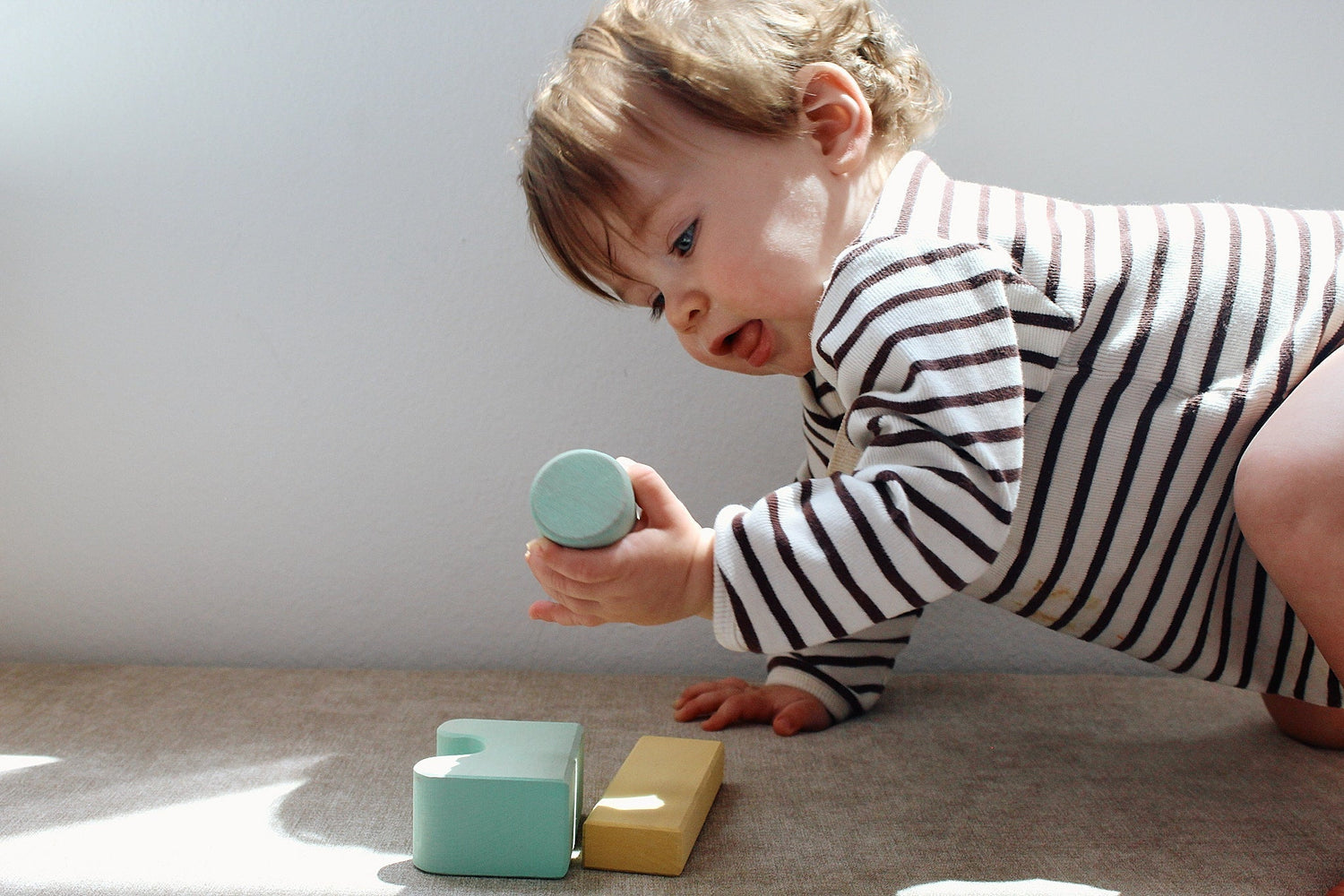
Between 8.5 and 12 months, babies typically begin banging two objects together. This is a real developmental milestone, not just noise-making. The arches are perfectly shaped for this kind of natural, exploratory behavior. If your baby is doing this, they're right on track.
12–24 Months: Stacking, Sorting, and Early Problem-Solving
Play Idea 4: Classic Stacking
Here's a fact that might reframe how you see your toddler's play: according to CDC milestone data, 75% of children can stack two blocks by around 15 months. That first wobbly tower isn't just cute. It's a genuine cognitive and motor achievement. When your child balances one arch on top of another, they're practicing spatial reasoning, hand-eye coordination, and cause-and-effect thinking all at once.
Play Idea 5: Size Sequencing
As toddlers approach their second birthday, they start to understand the concepts of "bigger" and "smaller." The graduated arches of a rainbow stacker make this tangible. Rather than teaching size through flashcards, let your child discover it through their hands. They'll naturally begin arranging arches by size, building an intuitive sense of order.
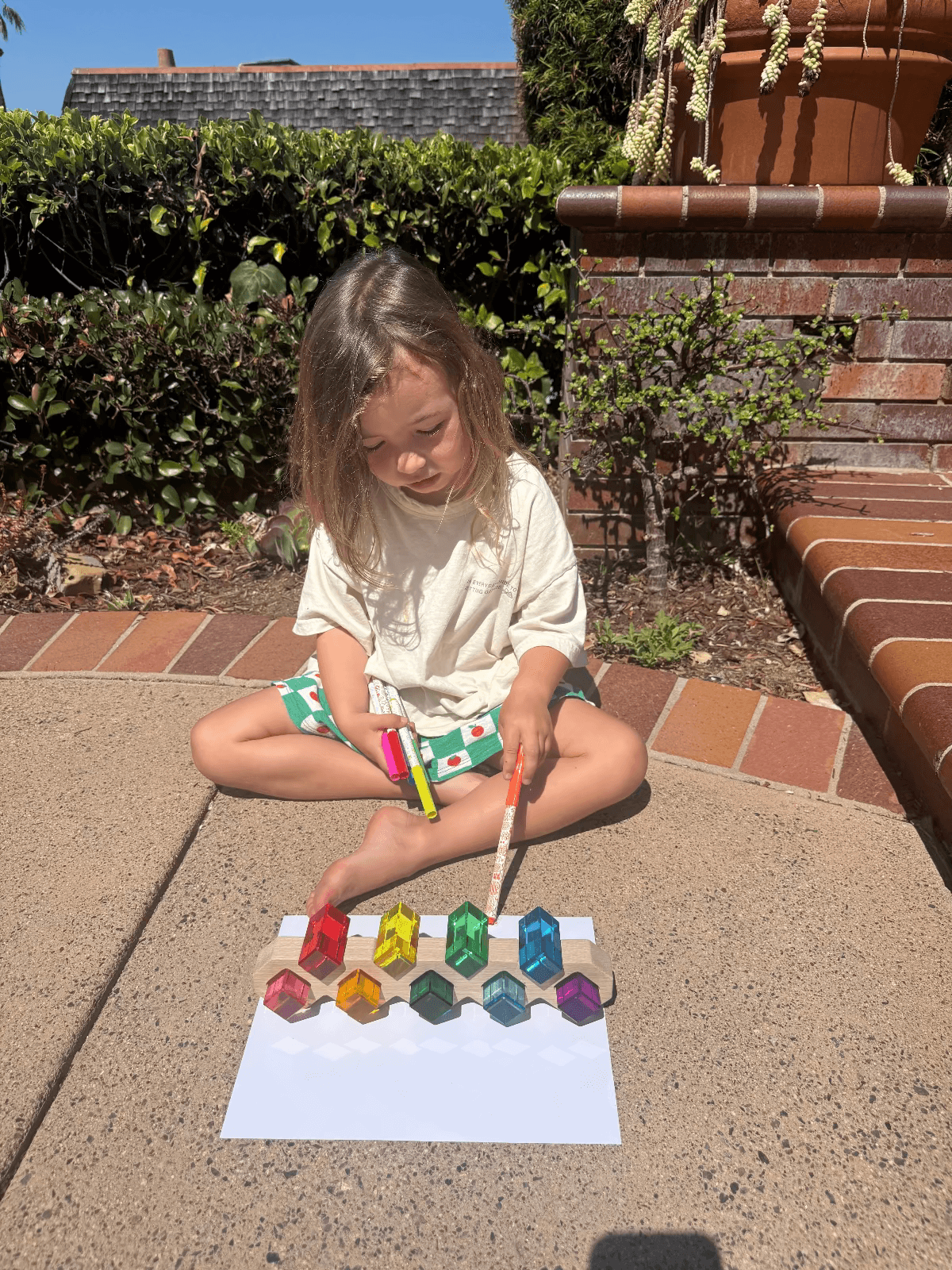
Play Idea 6: Color Sorting
Lay the arches flat on the floor and invite your toddler to group them by color. This is a natural entry point for what Montessori educators call the three-period lesson: name the color, recognize it, then recall it independently. It builds vocabulary through real, hands-on experience.
Research on children aged 1 to 3 has shown that those exposed to open-ended toys demonstrated measurable gains in attention span, memory retention, and logical thinking compared to children playing with fixed-function toys. The rainbow stacker fits squarely into this category.
Try this prompt with your toddler: "Can you find one that's the same color as your shirt?" It's simple, specific, and connects play to their everyday world.
2–3 Years: Imaginative Worlds Begin to Take Shape
Play Idea 7: Tunnel and Bridge Building
Around age two, something shifts. The arches stop being "just arches" and start becoming tunnels for toy animals, bridges over rivers made from a blue scarf, and roadways for small cars. This is the beginning of loose parts play, where children combine simple, open-ended materials to create their own scenes and stories. A few arches, a handful of figurines, and a piece of fabric can become an entire world.
Play Idea 8: Nesting and Enclosure Play
Children at this stage are naturally drawn to enclosing and containing things. Watch your child nest arches inside each other to create "houses," "caves," or "nests" for small figurines. This impulse to enclose is a well-documented play schema, and it supports spatial awareness and early geometry concepts without any formal instruction.
Play Idea 9: Parallel and Cooperative Play
Occupational therapists recommend stacking toys for the solitary play stage between ages 2 and 3, when children are building confidence in independent exploration. Add a second child playing alongside, and something new emerges: early social negotiation. "I need that arch." "Can I use the red one?" These small exchanges are the foundation of cooperative play.
A decade-long study by the Center for Early Childhood Education at Eastern Connecticut State University confirmed what many parents sense intuitively: simple, open-ended, non-realistic toys inspired the highest-quality play, including creative problem-solving, peer interaction, and richer language use.
This is also the perfect age to introduce a rainbow stacker on a Montessori shelf rotation. Presented alone on a low shelf, it invites child-led discovery without overwhelm.
3–5 Years: Storytelling, STEM, and Creative Mastery
Play Idea 10: Dramatic Role-Play and Storytelling
Ages 3 to 5 are the high season of imaginative play. Arches become castles, rainbows, portals to other dimensions, and stage sets for elaborate narratives that shift by the minute. A 2024 meta-analysis examining 34 studies found a clear positive relationship between pretend play and social competence in early childhood. When your child turns an arch into a dragon's cave, they're building empathy, perspective-taking, and emotional regulation.
Play Idea 11: Early STEM and Math Concepts
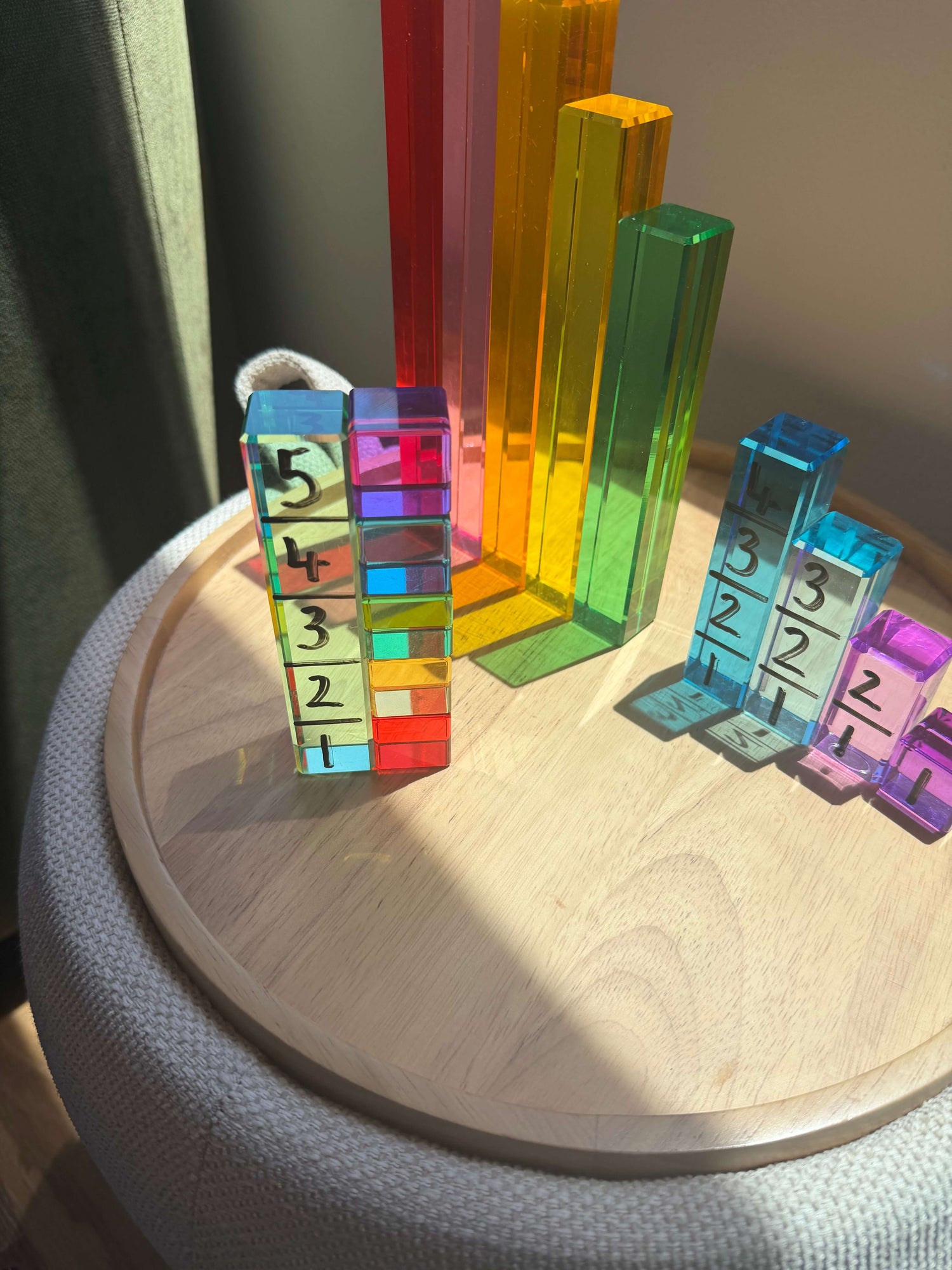
This is an angle many parents overlook. Use the arches for pattern making (red, blue, red, blue), counting, size ordering from largest to smallest, and early geometry conversations. What makes a curve different from a straight line? Can you make a symmetrical design? These aren't formal lessons. They're playful questions that plant mathematical seeds. Education-focused parents often find this dimension of the rainbow stacker especially rewarding.
Play Idea 12: Nature Play Integration
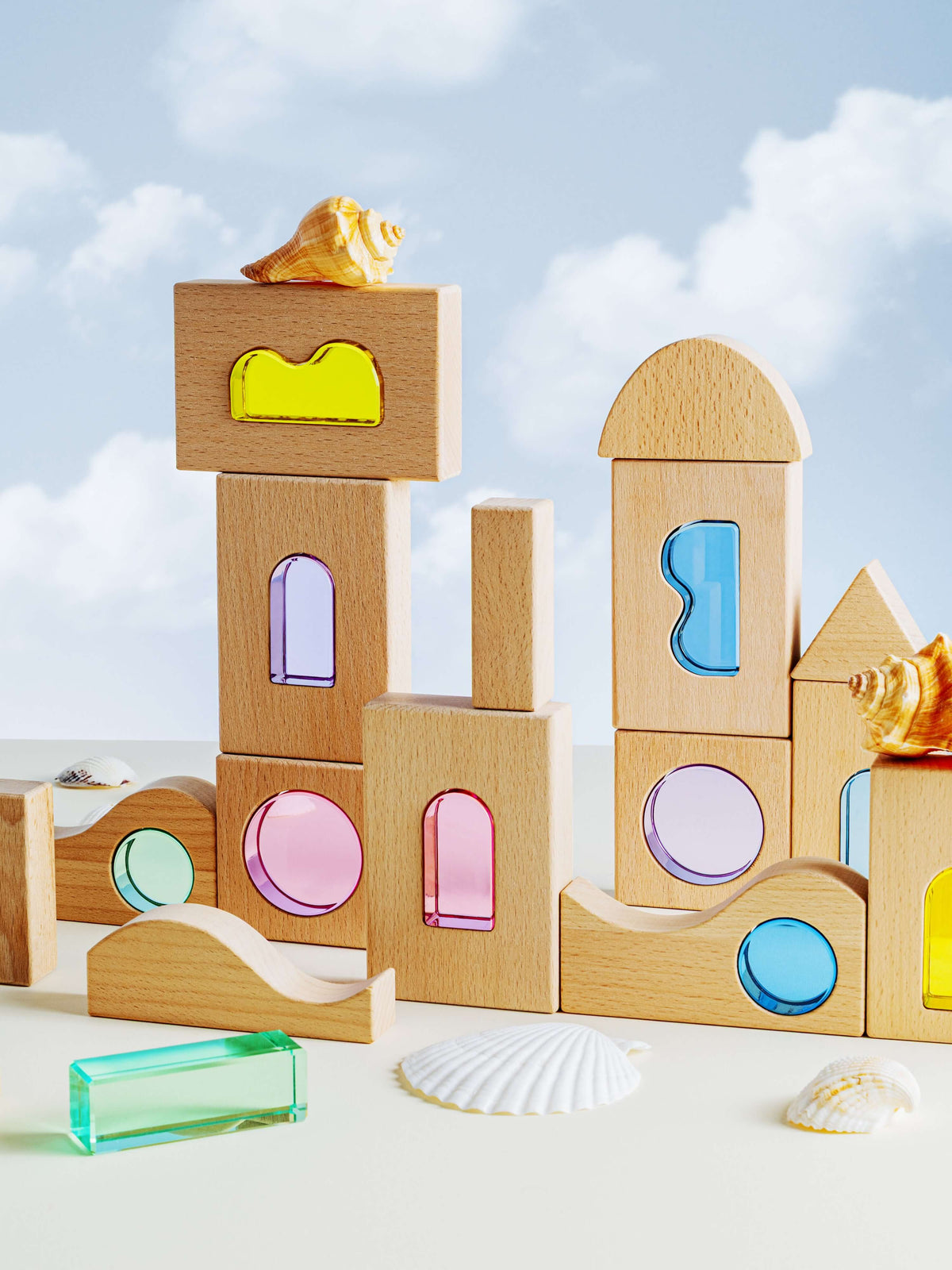
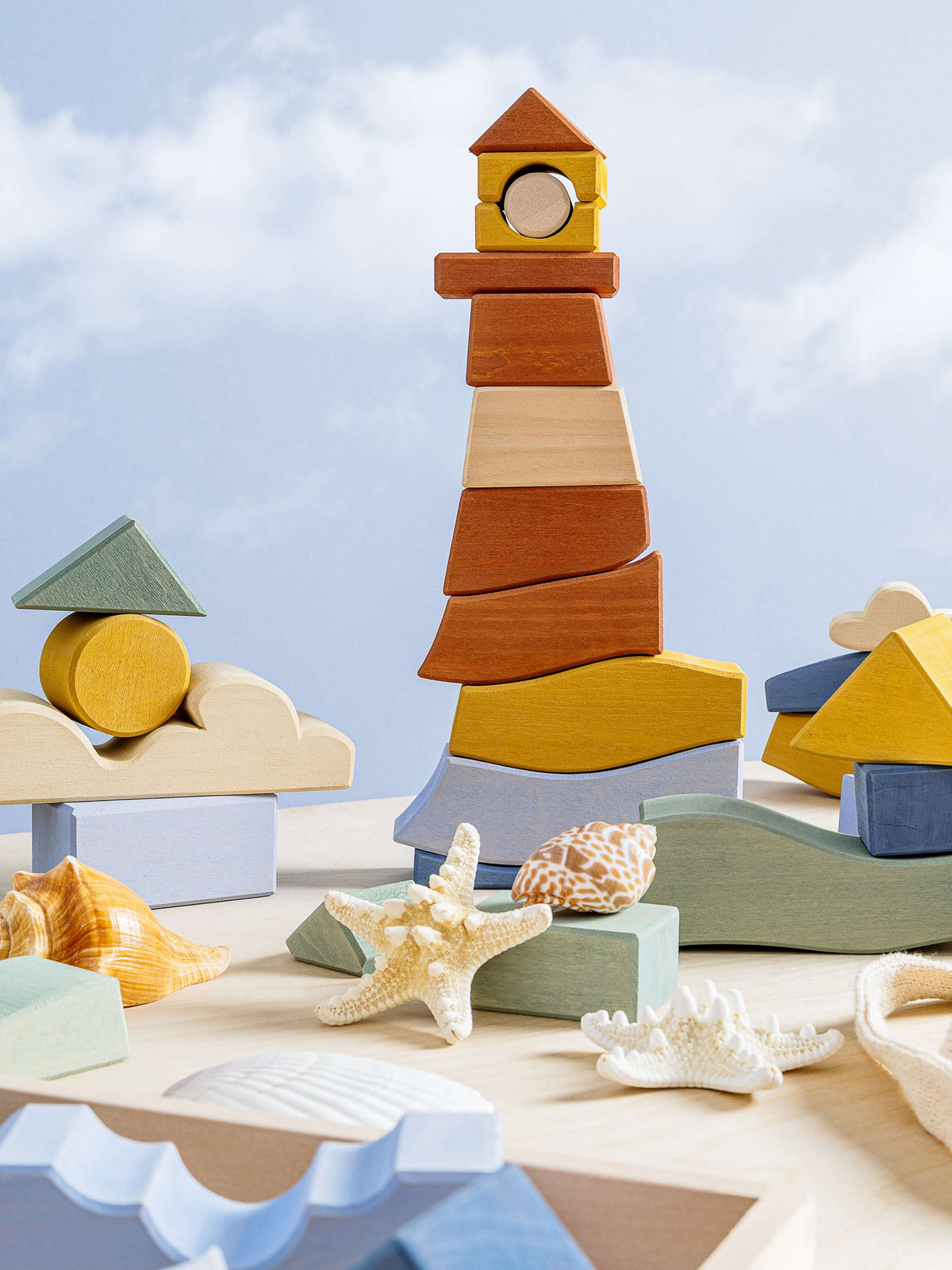
Combine arches with natural loose parts like pebbles, shells, moss, and small figurines to build fairy gardens, animal habitats, and sensory landscapes. This bridges indoor and outdoor play and gives children the chance to incorporate textures and materials from the real world into their imaginative constructions.
Research consistently shows that open-ended toys support language acquisition through symbolic play and narrative construction. When a child explains the story unfolding in their rainbow world, they're building vocabulary, practicing sentence structure, and developing metalinguistic awareness.
Try this prompt: "What story is happening in your rainbow world right now?" It models how adults can extend play without directing it.
For parents looking for a non-toxic, Montessori-aligned wooden rainbow stacker designed to support this full play arc, Maison Rue's rainbow stacker was built with exactly this developmental journey in mind.
Why One Open-Ended Toy Outperforms a Basket of Single-Use Ones
A premium wooden or acrylic toy that spans five years of development offers more developmental return than a bin full of single-use plastic toys discarded after a few months. You're not paying for one activity. You're investing in twelve (at minimum), plus every variation your child will invent on their own.
Nearly 58% of parents now prefer toys made from natural materials like wood, and 39% actively seek screen-free options. Rainbow stackers as a category have been a Waldorf and Montessori staple for over 40 years.
There's also the heirloom factor. A well-made wooden rainbow stacker can be passed to younger siblings, gifted to friends, donated to a classroom, or tucked away as a keepsake. That combination of economic and emotional value is hard to find in most toy aisles.
A Toy That Grows as They Do
The rainbow stacker is more than a stacking toy. It's a developmental companion that meets your child exactly where they are: mouthing an arch at six months or building a fairy kingdom at five.
Choosing one thoughtful, open-ended toy is an act of intentional parenting. Not minimalism for its own sake, but a quiet confidence that your child's imagination will do the rest.
We'd love for you to explore Maison Rue's full collection of open-ended wooden toys, each one designed with this same philosophy: beautiful enough for your home, purposeful enough for your child's growing mind. The best toy is the one that keeps being played with, differently, year after year.





0 commentaire