


Your Baby Sees Color Before They Can Say a Single Word
Here's something that might surprise you: infants as young as four to six months old can categorize colors into five distinct groups (red, yellow, green, blue, and purple) long before they utter their first word. This isn't something they learn from us. It appears to be biologically innate.
Using fNIRS brain imaging, researchers have shown that the brains of five- to seven-month-old babies respond differently when colors shift across categories (say, green to blue) compared to shifts within a single category (one shade of green to another). Their brains are already sorting the world by color, without any instruction.
What does this mean for the toys we choose? Color-rich play materials aren't just pretty. They meet a child's developing brain exactly where it already is. The question isn't whether your baby notices color. It's whether the objects in their hands are working with their neuroscience or ignoring it entirely.
What the 2025 Science Actually Says About Children and Color
A landmark 2025 study from Kyoto University, published in the Proceedings of the National Academy of Sciences (PNAS), revealed something remarkable: children as young as three experience the relationships between colors in much the same way adults do. The consistency held across ages and cultures, suggesting that basic color experience may be far more universal than researchers previously assumed.
This finding reframes rainbow toys entirely. They aren't simple playthings for developing minds. They're sophisticated perceptual tools that align with how children already process the visual world.
The neuroscience goes deeper. In babies, color categorization is primarily handled by the right hemisphere of the brain. As children begin learning color words, that processing shifts leftward, toward the brain's language center. Color perception and language acquisition are intertwined from the start.
That connection has practical consequences. Research on three- and four-year-olds has found that children with richer color vocabularies also demonstrate stronger color constancy, the ability to perceive a color as stable even when lighting conditions change. Learning color words doesn't just label the world; it sharpens how children see it.
There's also a critical developmental window to consider. At around age three, color is the most salient property children use to understand objects. They make 55% of object matches based on color, compared to just 26% based on shape. Color is their primary lens for organizing reality. By age four, shape overtakes color as the dominant sorting attribute, which helps explain why the type of play that serves a three-year-old looks different from what a five-year-old needs.
Wooden vs. Acrylic: Two Materials, Two Distinct Sensory Experiences
Most articles about rainbow blocks treat wooden and acrylic versions as interchangeable. They aren't. These two materials offer fundamentally different sensory inputs, and understanding the distinction helps you choose with intention.
Wooden stackers provide warm tactile feedback. They carry real weight. A child gripping a solid beechwood arc feels the grain, registers the heft, and develops proprioceptive awareness (the body's sense of its own position and force). This kind of haptic engagement supports fine motor development and sensory integration in ways that lighter materials simply cannot replicate.
The Large Wooden Rainbow (Preorder) is a 10-piece stacker finished in non-toxic, water-based stains, offering the warm tactile weight of solid wood with heirloom-quality construction built to last through years of play and multiple children.
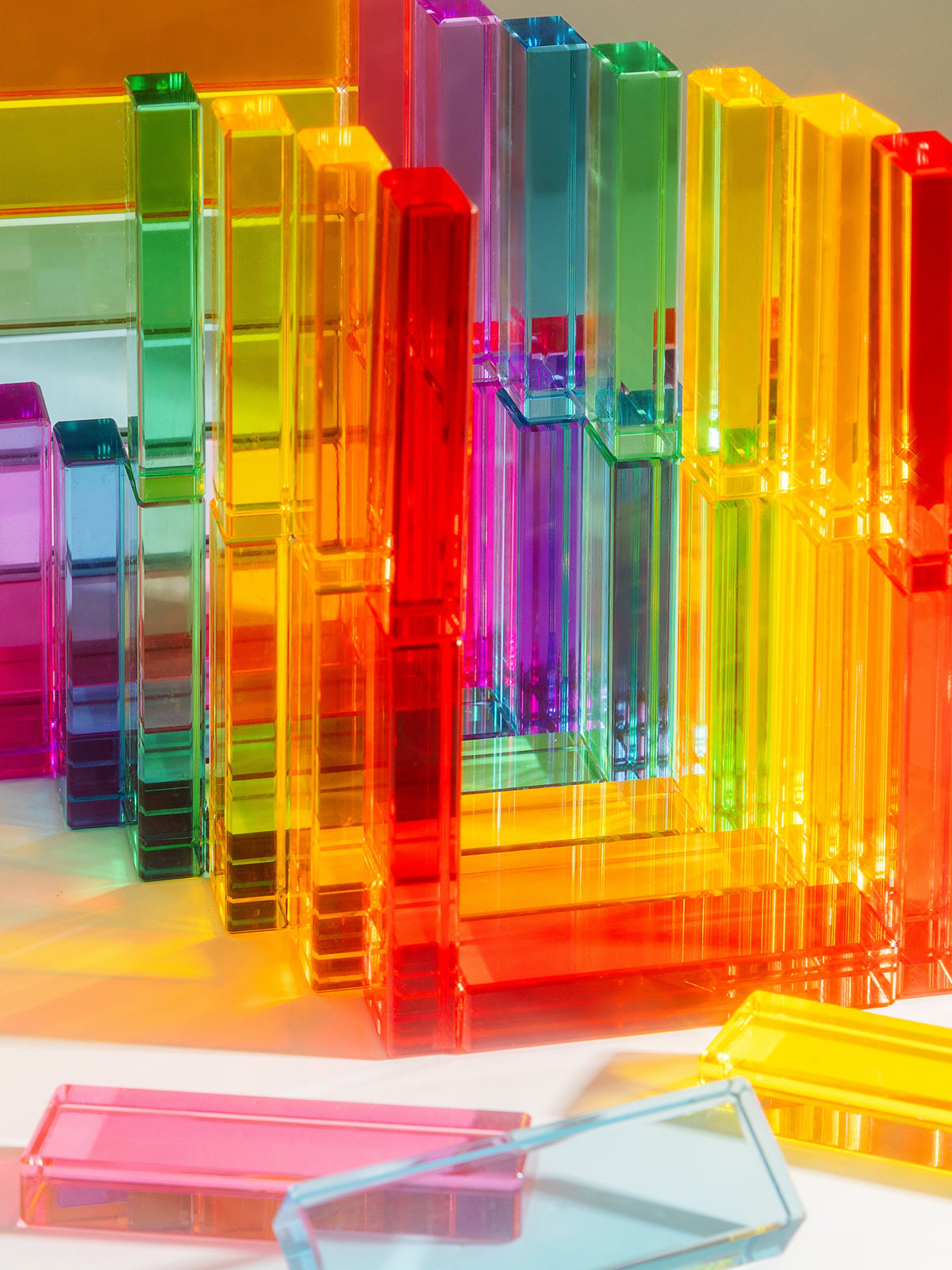
Acrylic and translucent blocks interact with light in ways wood cannot. Place them near a window, and they become a child's first physics experiment. Color mixing, refraction, shadow play: these are real optical phenomena happening in a toddler's hands. The sensory experience is visual and spatial rather than primarily tactile.
The Lucid Rainbow acrylic rainbow stacker is designed specifically for this kind of light exploration and open-ended stacking, letting children observe how translucent prisms interact with natural light throughout the day.
A 2025 study on multisensory integration found that this capacity reaches maturity late in childhood, making early sensory experiences especially critical for optimal neural development. The more varied and rich those early inputs, the stronger the foundation.
Non-electronic traditional toys commanded 56% of the educational toys market in 2025, a clear signal that parents are choosing hands-on, tangible play over screen-based alternatives.
For families who want both material worlds, the Noa Blocks combine translucent acrylic color with a sleek wooden tray, bridging tactile and visual play while supporting color recognition, fine motor skills, and light display exploration.
The Developmental Arc: What Color Does for Children at Every Age
0–6 months: Infants tend to prefer bright, warm colors like red and yellow over cooler tones. High-contrast and saturated hues help babies distinguish the edges of objects, supporting foundational visual development during a period when their eyesight is still maturing rapidly.
6–12 months: Categorical color perception sharpens. Babies begin showing clear preferences for specific colors, and their brains respond measurably to cross-category color shifts. Color-rich toys provide the visual variety their developing neural pathways are actively seeking.
12–36 months: Color learning peaks. Consistent and accurate color identification typically emerges between ages three and four. This is the window when color-rich, open-ended toys have the greatest perceptual impact, reinforcing both visual discrimination and the color vocabulary that strengthens it.
3–5 years: The benefits extend well beyond color itself. In a randomized controlled trial of 175 children aged 1.5 to 2.5 years, those who played with blocks scored 15% higher on language assessments than those who did not. Block play connects directly to literacy readiness.
This isn't coincidental. Research grounded in Gibson's ecological optics theory and Kephart's perceptual-motor theory has shown that visual perception in preschoolers significantly predicts future literacy development. Color-rich visual play isn't just sensory; it's academically consequential.
What makes rainbow blocks especially compelling is their longevity. A single set evolves with your child: from visual stimulation at four months, to sorting and stacking at eighteen months, to color mixing experiments and imaginative world-building at age five. One toy, five years of meaningful play.
Beautiful by Design: Why Aesthetic Toys Are a Developmental Choice
If you've ever felt a twinge of guilt for choosing a toy partly because it looks beautiful on the shelf, let that go. Choosing objects that live gracefully in your home is not vanity. It's an intentional act that shapes your child's aesthetic sensibility from infancy.
The Montessori principle of the prepared environment holds that beautiful, orderly spaces invite deeper, more focused engagement. Nordic-inspired, thoughtfully designed toys are a natural extension of that philosophy. When a toy belongs in the room rather than being hidden in a bin, it gets played with more often and more thoughtfully.
The global educational toys market reached approximately $72 billion in 2025, with the 0–4 age segment growing fastest at an 11.12% CAGR. Parents are increasingly seeking toys that are developmental and design-forward.
There's also a therapeutic dimension worth noting. Translucent and acrylic blocks are increasingly used in occupational therapy settings for children with sensory processing differences, autism, and ADHD. The interplay of color and light offers calming, regulating sensory input that supports a wide range of developmental needs.
Every Maison Rue Kid product is designed by a founder with a degree in early childhood education and tested to CPSIA and CPC safety standards. That combination of pedagogical grounding and material transparency is why our toys have been featured in Vogue, Babylist, and Milk Magazine. It's not aesthetics alone. It's about getting both the science and the beauty right.
Choosing Toys That Work With Your Child's Brain
Color is not decoration in early childhood. It is a primary cognitive tool, one your child's brain is wired to use from the very first months of life. The toys you place in their hands either honor that science or overlook it.
Think of rainbow blocks as sensory infrastructure: tools that support language, visual perception, fine motor development, and early STEM thinking all at once. They're not accessories to play. They are the play.
Our collection of non-toxic, thoughtfully crafted rainbow toys was designed for exactly this purpose: to bring everyday wonder into your child's hands, and to do it beautifully.
0 comentarios