
The Literacy Crisis Starts Earlier Than You Think
Approximately 64% of U.S. fourth-graders are not reading proficiently as of the 2024–2025 school year. That number is staggering, but reading struggles rarely begin in fourth grade. Their roots reach back to the toddler years.
From birth to age six, a child's brain forms more than one million new neural connections every second. This is the most critical window for building the foundations that support reading, writing, and language. Among those foundations, alphabet knowledge stands out as one of the strongest early predictors of later reading ability in alphabetic languages like English.
So what does this mean for the puzzle your toddler is reaching for right now? More than you might think. Here is what the research actually tells us about alphabet puzzles as a meaningful pre-literacy tool.
What Research Says About Alphabet Knowledge and Reading
When researchers talk about alphabet knowledge, they are really describing two distinct skills: letter-name knowledge (knowing that the symbol "B" is called "bee") and letter-sound knowledge (knowing that "B" makes a /b/ sound). Both matter. Letter-name knowledge helps children recognize and talk about print, while letter-sound knowledge is essential for decoding words and spelling.
A 2025 peer-reviewed study tracking 518 U.S. preschoolers found something important: it is not just what a child knows about letters at any given moment, but how fast their alphabet knowledge grows that predicts Grade 1 reading and spelling outcomes. Growth trajectories matter as much as starting points.
There is also a reinforcing loop at work. Research shows that alphabet knowledge and phonological awareness (the ability to hear and manipulate sounds in words) are bidirectionally related during preschool. As a child learns more letters, their sound awareness improves, and vice versa. Each skill feeds the other.
Children with limited letter knowledge in preschool and kindergarten face a greater risk of reading difficulties later on, which makes early exposure essential. The good news? Parents are already doing this work instinctively. According to NCES survey data, 96% of children aged 3–5 were taught letters, words, or numbers by a family member at least once in the surveyed week. The impulse is there. The question is which tools amplify it best.
Why Puzzles, Not Flashcards or Screens, Make a Difference
Not all alphabet tools are created equal. A 2025 comparative study found that children who learned through alphabet puzzles showed stronger reading performance and higher enthusiasm in classroom activities than those who used picture cards or flashcards. The difference comes down to how the brain encodes information.
Puzzle play is inherently multisensory. When a child picks up a wooden letter, turns it, feels its shape, and fits it into a matching slot, they engage visual, tactile, and kinesthetic pathways simultaneously. This creates stronger neurological imprints than screen-based or purely visual methods, which tend to activate fewer sensory channels.
This principle is central to the Montessori approach. Materials like sandpaper letters and the moveable alphabet were designed specifically to engage three senses at once, building deeper letter recognition than rote memorization ever could. It is the difference between seeing a letter and knowing a letter.
The cognitive benefits extend beyond literacy, too. A pre/post-test intervention study found that puzzle play has a statistically significant positive effect on children's cognitive development, with a t-value of -10.721 (p=0.000). Puzzle-based learning stimulates classification, symbol recognition, and spatial reasoning, all of which are foundational to pre-literacy.
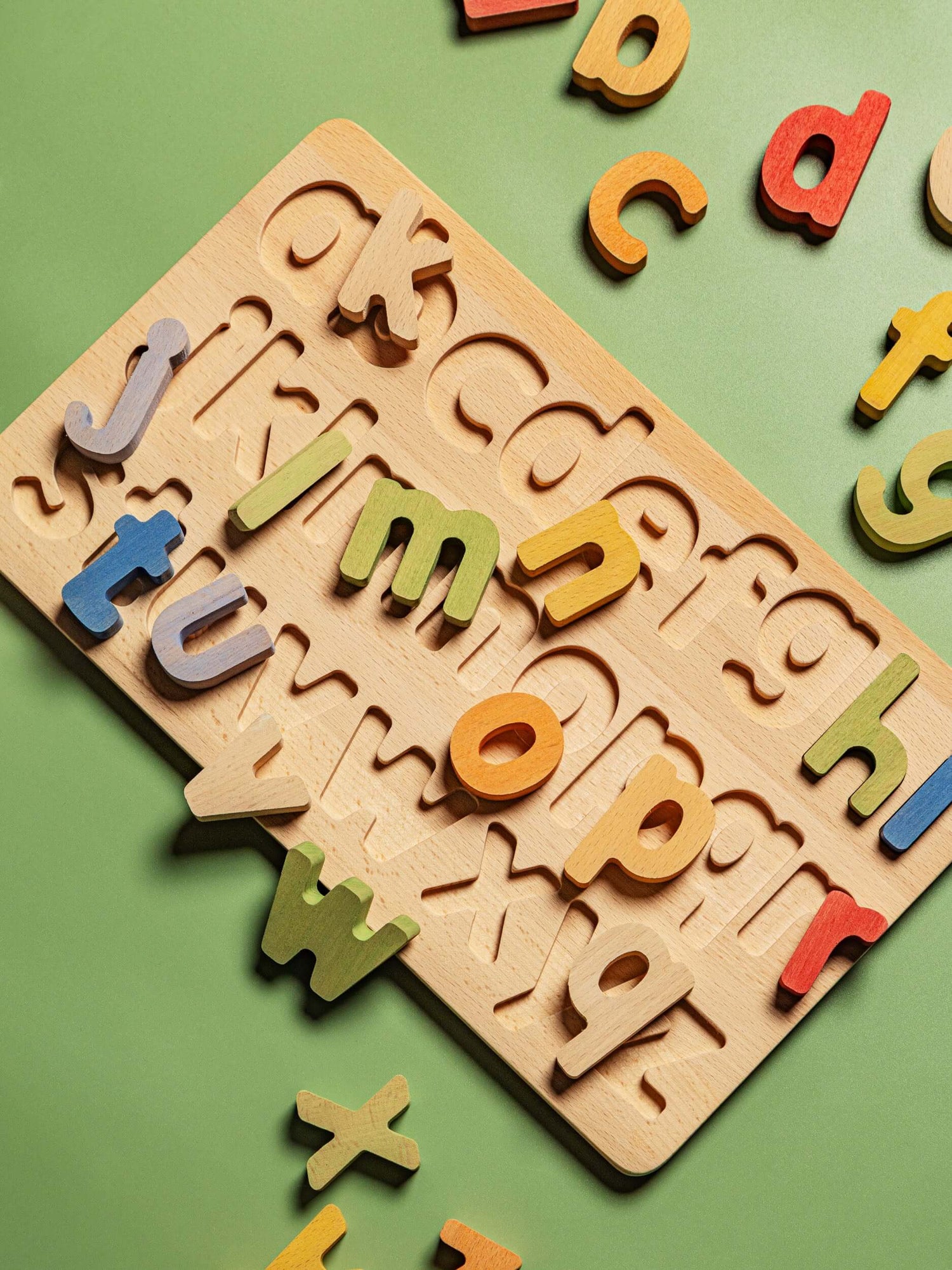
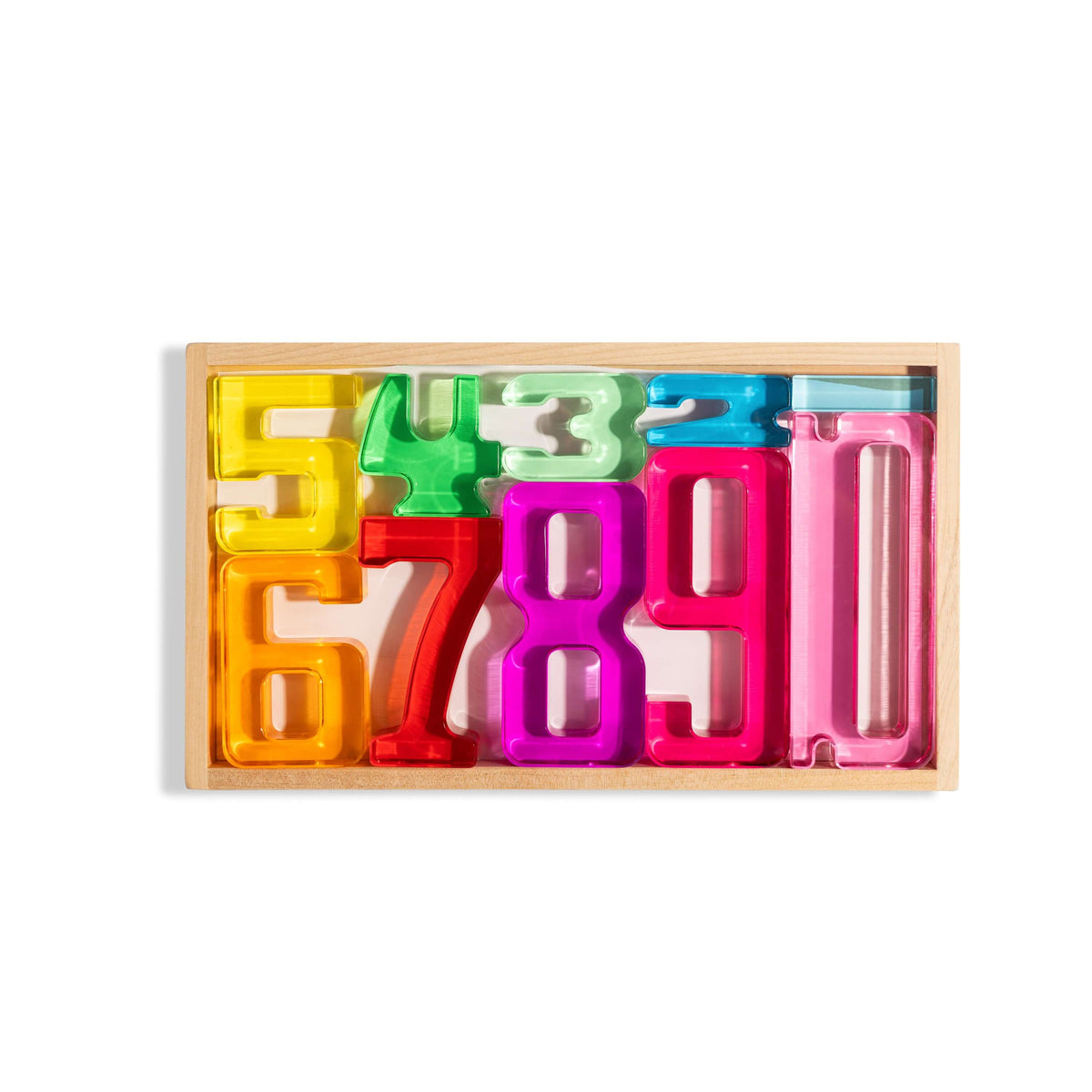
The Alphabet Puzzle from Maison Rue is one example of a tactile, design-intentional tool that brings this multisensory approach into the home environment naturally, pairing developmental purpose with a form that fits your living space.
The Fine Motor Connection: How Puzzle Play Builds Handwriting Readiness
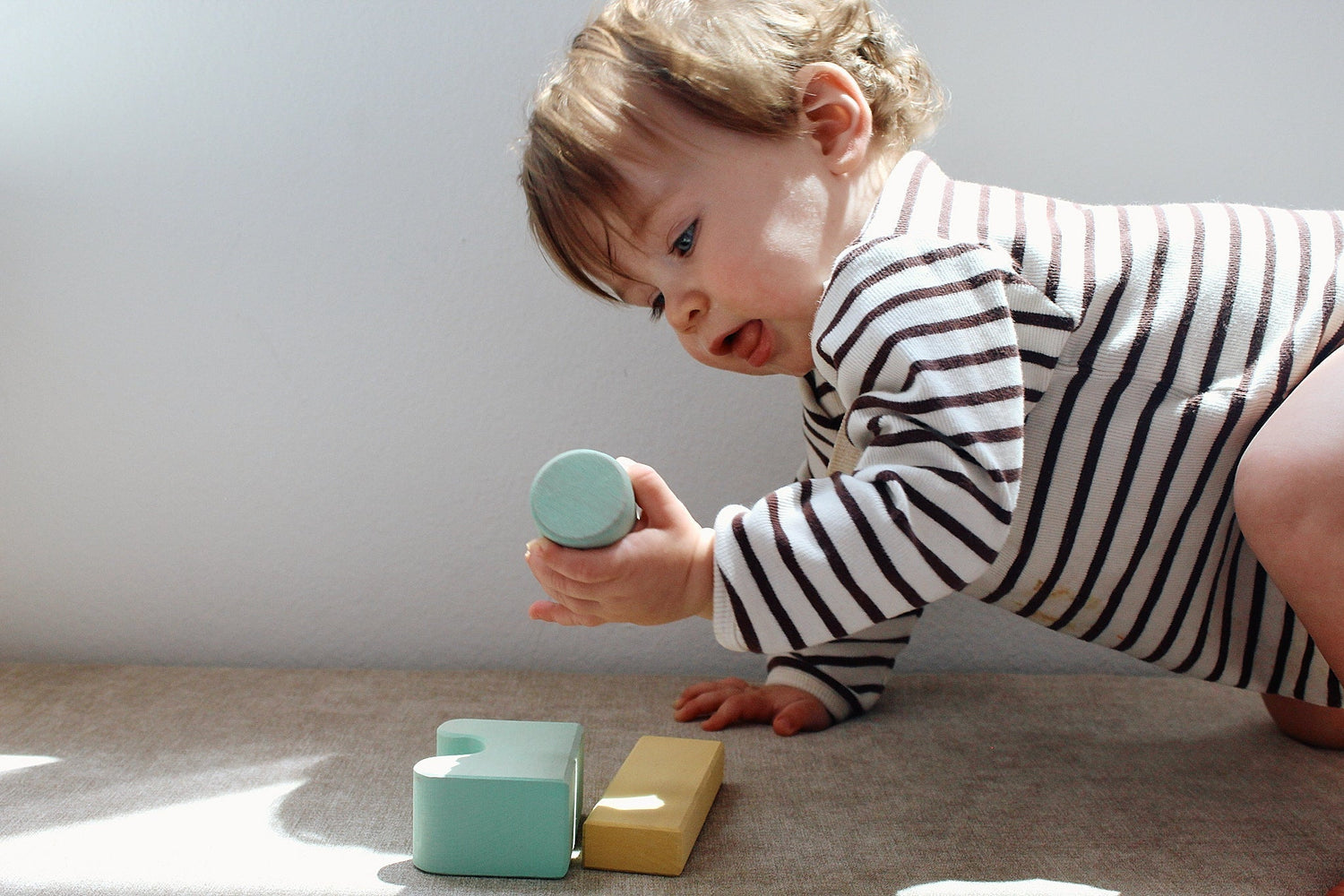
There is a developmental link between puzzle play and handwriting that often goes overlooked. Wooden puzzle pieces, especially those with knobs, encourage the pincer grasp (the thumb-and-forefinger grip that typically develops around 9–12 months). This same grasp is directly tied to the fine motor control children need for holding a pencil and forming letters later on.
Manipulating puzzle pieces also stimulates executive functions, metacognition, and visuospatial abilities in children aged 4–6. Kids develop strategies for problem-solving, learn to self-correct, and strengthen hand-eye coordination, all while playing.
This makes alphabet puzzles genuinely dual-purpose: they build both literacy foundations and motor skills at the same time. The toddler window (roughly 18 months to 3 years) is a particularly valuable phase for sensory exposure to letter shapes. Children at this age are not ready for formal instruction, but they are primed for tactile exploration. Letting small hands trace and place letter forms lays groundwork for pre-writing readiness long before a worksheet enters the picture.
How to Play Alongside Your Toddler to Multiply the Benefit
The research is clear: caregiver co-play is a literacy multiplier. When an adult sits alongside a child during puzzle play, naming letters, modeling sounds, and asking open-ended questions, pre-literacy outcomes improve dramatically. Higher levels of early literacy engagement at home are associated with more advanced letter-knowledge growth trajectories.
A Montessori-informed approach suggests introducing letters by their phonetic sound rather than in alphabetical order. This nurtures phonological awareness and lays the groundwork for blending and segmenting, skills essential for reading and spelling.
You do not need a curriculum to do this well. Try three simple prompts during puzzle play:
- Name the letter aloud: "This is the letter S."
- Say its sound: "It makes a /sss/ sound."
- Connect it to a familiar word: "S is for sun, like the sun we saw this morning."
Warm, consistent play is enough. You do not need to turn every session into a lesson. The connection you are building between letters, sounds, and your child's own world is the real work happening here.
Play Is the Foundation, and You're Already Building It
If you are choosing intentional, research-backed play tools for your child, you are already doing something meaningful. The trajectory research tells us that consistent, joyful alphabet play builds the growth curve that predicts reading success. It is not a snapshot of what your child knows today that matters most; it is the momentum you are creating together.
The toddler years are not too early. They are exactly the right time. And the best literacy tool is one your child reaches for again and again.





0 comentarios