


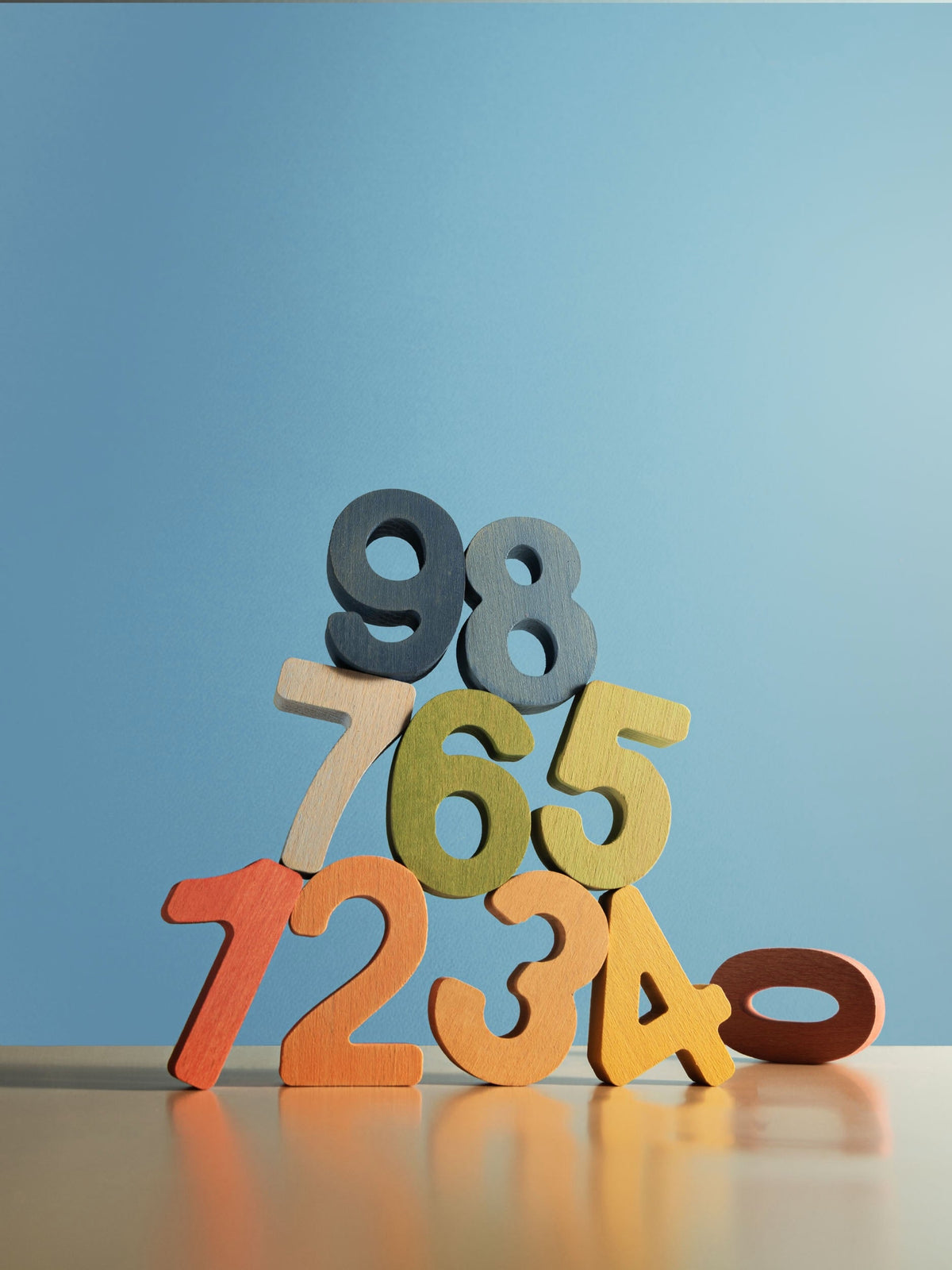
Your Toddler Is Already Doing Math
Here's something that still amazes me as both a parent and someone with a degree in early childhood education: research shows that infants as young as five months old are sensitive to addition and subtraction. Place three balls in a container, remove one, and a toddler will search for exactly two. They already have a sense of quantity before they can walk.
This means that when your little one picks up a wooden number puzzle, they're not just playing. They're engaging an early numeracy system that's already active in their brain. A 2025 peer-reviewed study in Infant and Child Development (Wiley) confirmed that foundational math skills, including counting, cardinality, and number sense, begin forming around age 2. So what exactly is happening in your toddler's brain during number puzzle play? Let me walk you through it in plain, parent-friendly terms.
What Number Puzzles Teach That Other Puzzles Don't
Shape puzzles build spatial awareness. Animal puzzles build vocabulary. But wooden number puzzles do something more specific: they build the architecture of mathematical thinking.
When your child places the numeral "3" into its slot, they're learning cardinality, the understanding that the symbol 3 represents a quantity of three things. When they touch each piece one at a time, they're practicing one-to-one correspondence. And when they line up 1 through 5 in order, they're constructing what researchers call the mental number line, the internal framework that underpins all future arithmetic.
There's another skill at work here that almost never comes up in parenting conversations: subitizing. This is the ability to instantly recognize a small quantity (say, two or three dots) without counting each one. It's a critical early numeracy milestone, and number puzzle play supports it naturally.
A landmark analysis of six large longitudinal studies, tracking over 16,000 children, found that early math skills at school entry are the single strongest predictor of later academic success, stronger than early reading and stronger than attention skills. The foundation starts here.
The Neuroscience at the Play Mat
Puzzle play is one of the few activities that engages both hemispheres of the brain at once. The left hemisphere handles numeral recognition and logical sequencing. The right hemisphere manages spatial reasoning and shape rotation. When your toddler picks up a wooden "4" and turns it to fit its slot, both sides of the brain are firing together.
Research from the University of Chicago, led by Susan Levine, found that children who play with puzzles between ages 2 and 4 show measurably better spatial skills when assessed at 54 months, performing better specifically on tasks involving shape rotation and translation. These abilities are strong predictors of later STEM success.
And the material matters. Solid beechwood pieces have weight, grain, and texture that plastic simply can't replicate. That sensory richness provides proprioceptive input, the kind of deep tactile feedback that supports sensory integration alongside cognitive development. Your child isn't just seeing a number; they're feeling it.
The fine motor work is significant too. Pinching, placing, and correcting puzzle pieces strengthens the small hand muscles and hand-eye coordination that children will later use to write numerals and draw shapes. Every attempt, even the "wrong" ones, is building dexterity and control.
How Number Puzzle Play Grows With Your Child
12 to 18 months: At this stage, the focus is sensory and motor. Your baby might mouth the pieces, bang them together, or place a single large piece into its slot. That's perfect. They're building tactile familiarity and hand-eye coordination. Numerals are being absorbed visually, with no expectation of recognition.
2 to 3 years: This is where the cognitive load increases. Children begin matching a numeral to its quantity, attempting sequencing, and self-correcting when a piece doesn't fit. Cardinality and one-to-one correspondence are actively developing during this window.
4 to 5 years: Now children can use number puzzles to practice ordinal language (first, second, third), try skip-counting, and extend play into simple addition stories using physical pieces. The puzzle becomes a springboard for mathematical storytelling.
For families looking for a tactile, open-ended complement to number puzzles that grows with this progression, Number Puzzle from Maison Rue are designed with solid beechwood and translucent acrylic, tested to CPSIA and CPC standards.
One more thing that makes a real difference: number talk. Susan Levine's research at the University of Chicago shows that parental math talk significantly amplifies developmental outcomes. Name quantities out loud. Ask "how many?" Point to numerals and use spatial language ("the 2 goes before the 3"). These small conversational habits compound over time.
Why This Matters More Than You Might Think
Here's a statistic worth sitting with: children in the bottom 10% of math ability at age 5 have a 70% chance of remaining in the bottom 25% of their class through middle school. That's not meant to alarm you. It's meant to reframe what that simple wooden puzzle on your floor is actually doing.
Every dollar invested in early numeracy saves roughly $7 in later remedial education costs. A well-made wooden number puzzle isn't a discretionary purchase. It's one of the highest-return developmental investments you can make.
And beyond the numbers, something equally important happens in those moments when your toddler tries a wrong piece and tries again. That's frustration tolerance. That's a growth mindset forming. That's the kind of persistence and math confidence that prevents math anxiety years down the road.
Choosing a beautiful, non-toxic wooden number puzzle is both an aesthetic and an educational act. A small, everyday object doing extraordinary developmental work, right there on your play mat.
0 comments