
Introduction
If you’ve ever tried to move your child from one activity to another—playtime to dinner, bath to bedtime—you already know:
Transitions can be hard.
Not because children are being difficult, but because they’re being asked to stop something they’re engaged in… without always knowing what comes next.
A daily routine chart changes that.
It gives children a visual understanding of their day—so instead of reacting, they can anticipate.
And that small shift makes a big difference.
Why Transitions Are So Challenging for Kids
Young children thrive on predictability.
When they don’t know what’s coming next, transitions can feel:
- Sudden
- Disruptive
- Out of their control
This often shows up as:
- Resistance
- Frustration
- Meltdowns
A routine chart removes the uncertainty.
It answers the question they’re constantly asking:
“What happens next?”
How a Daily Routine Chart Helps
A visual routine chart supports children in three key ways:
1. It Creates Predictability
When children can see their day, they feel more secure.
They begin to understand:
- What’s happening now
- What’s coming next
- What to expect later
This reduces anxiety and resistance.
2. It Supports Smoother Transitions
Instead of saying:
→ “Time to clean up” (cue meltdown)
You can say:
→ “Let’s check what’s next”
The chart becomes the guide—not you.
And somehow… that makes you the good guy again.
3. It Builds Independence
Over time, children begin to:
- Follow the routine on their own
- Complete tasks independently
- Take ownership of their day
It’s a small tool with a big long-term impact.
You can read more about Independent play here.
How to Use a Routine Chart in Your Daily Life
This is where most people overcomplicate things—don’t.
Simple always works better.
Step 1: Start with Just One Part of the Day
You don’t need to map out everything.
Start with:
- Morning routine
or - Bedtime routine
These are the moments where transitions tend to be hardest.
Step 2: Walk Through It Together
At the start, treat it like an activity:
- Show each step
- Name it together
- Let your child move or point to each task
Repetition builds familiarity.
Step 3: Use It Before the Transition
The key is timing.
Don’t introduce it mid-meltdown.
Instead:
- Reference it before the change
- Give a gentle heads up
- Let them see what’s next
Step 4: Let Them Take the Lead
As they get comfortable, step back.
You’ll start to hear things like:
→ “Next is snack!”
→ “We have to clean up first!”
That’s when you know it’s working.
Step 5: Keep It Flexible
Life happens.
The goal isn’t perfection—it’s predictability.
Even a loose structure helps children feel more grounded.
Real-Life Examples of When It Helps Most
A routine chart is especially helpful during:
- Morning rush
- Leaving the house
- Nap/quiet time transitions
- Bedtime routines
- Switching from play to structured activities
These are the moments where “out of nowhere” transitions tend to cause the most friction.
Download Your Free Daily Routine Chart
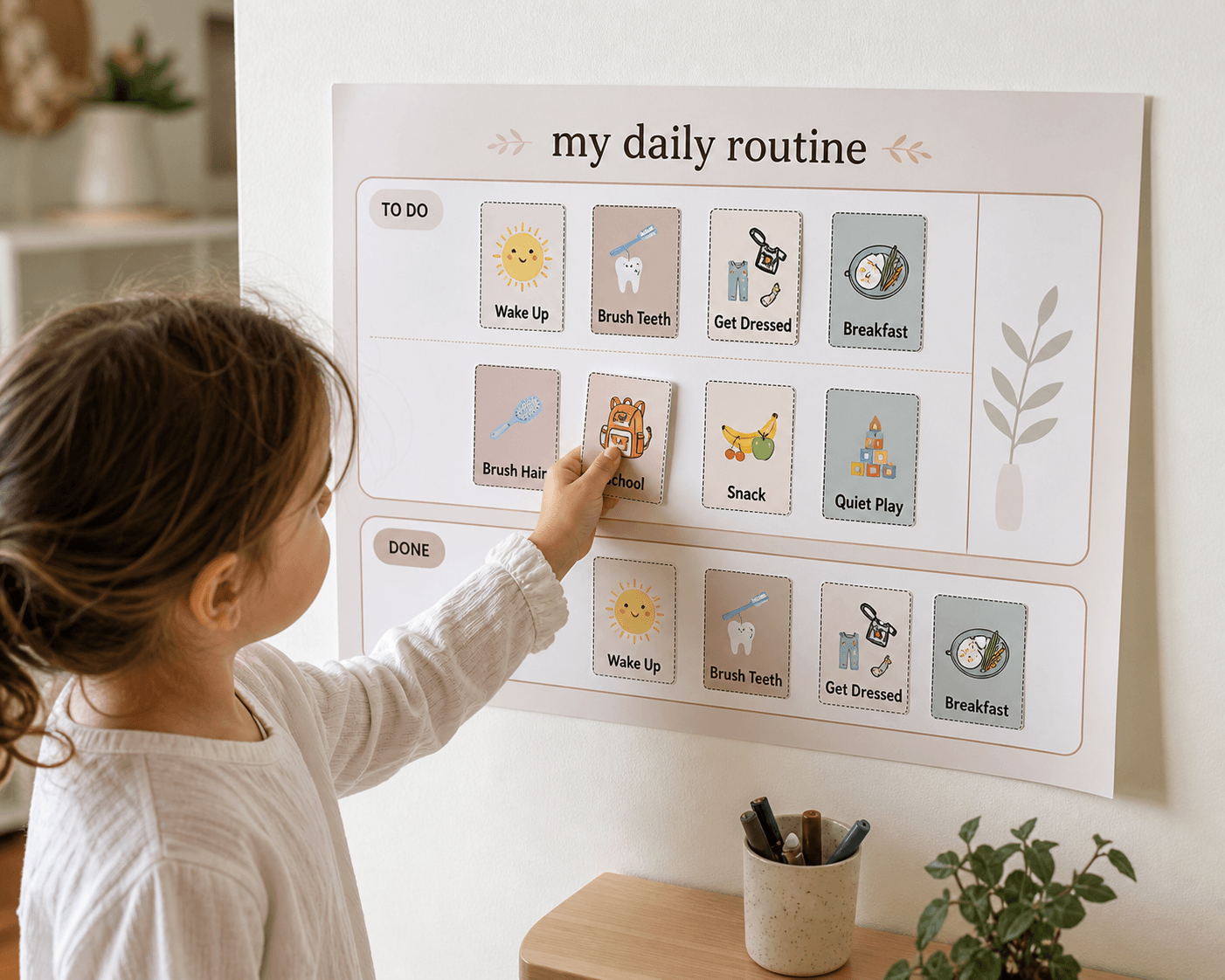
To make this easy, we created a Free Daily Routine Chart For Kids you can start using right away:
Inside, you’ll find:
- Morning, afternoon, and evening routine templates
- Visual task cards like wake up, brush teeth, snack, outdoors, bedtime
- A simple “to do” and “done” system for hands-on engagement
They include simple, everyday moments like Wake Up, Brush Teeth, Get Dressed, Snack, Outdoors, and Bedtime—making it easy for even young children to follow along independently.
The best way to use them is by printing, laminating and applying velcro dots so that it can be used again and again.
Activity Idea: Make It Interactive
Turn your routine chart into a daily ritual:
- Cut out the cards together
- Let your child arrange their routine
- Move tasks from “to do” to “done”
This adds a tactile, engaging element—and gives them a sense of control.
Final Thoughts
Most meltdowns around transitions aren’t about behavior.
They’re about uncertainty.
When children know what to expect, everything softens:
- Transitions feel smoother
- Resistance decreases
- Confidence grows
And your day starts to feel just a little more… predictable.







0 commentaire