


Why Grandparents Are the Secret Champions of Better Toy Buying
If you're a grandparent shopping for a young grandchild, you know the challenge: you may not see them every day, you might be unsure of their exact developmental stage, and you want to give something meaningful rather than something that ends up in a donation bin by February.
As a founder with a degree in early childhood education, I wrote this guide to offer genuine, educator-backed advice rather than another generic listicle. By the end, you'll know exactly what to look for, what to avoid, and why wooden toys are the gift parents will actually thank you for. Grandparents who choose thoughtfully are powerful allies in the screen-free, open-ended play movement that so many parents care deeply about right now.
What an Early Childhood Educator Actually Looks for in a Toy
Before spending a dollar, it helps to understand one simple distinction: open-ended versus closed-ended toys. A closed-ended toy has one outcome. Press a button, hear a sound, watch a light flash. An open-ended toy becomes whatever the child imagines it to be. A wooden block can be a tower, a bridge, a loaf of bread, or a phone. That flexibility is where real learning happens.
The American Academy of Pediatrics confirms that hands-on, open-ended play is one of the most powerful drivers of cognitive development in children under six. It builds language, problem-solving skills, and emotional regulation all at once.
Here's a useful habit: before buying any toy, ask yourself one question. "Can this toy be played with in more than one way?" If yes, it earns its place. If it only does one thing, it will likely be abandoned within a week.
Wooden materials specifically support fine motor development. Roughly 85% of early childhood educators prefer wood because it requires more precise grip and force control than lightweight plastic. Children under three show 20% longer play sessions with wooden toys compared to plastic toys loaded with lights and sounds, because simple materials reduce sensory overload rather than creating it.
The language benefits are striking, too. Children who interact with simple, non-electronic toys exhibit a 40% higher rate of spontaneous language generation during play compared to those using battery-operated alternatives, according to AAP research.
One honest warning: the market is flooded with toys labelled "Montessori" that don't meet the actual criteria. The word has become a marketing shortcut. The real tests are open-endedness and material quality, not the label on the box. If a toy lights up, makes noise, and only does one thing, calling it Montessori doesn't make it so.
The Age-by-Age Cheat Sheet: What to Buy for Each Stage Under 5
This is the section to screenshot. Think of it as a practical developmental map you can pull up on your phone while shopping.
Ages 0–1: Sensory Exploration
At this stage, babies are discovering the world through touch, taste, and sound. Smooth wooden rattles and simple grasping toys are ideal. The goal is tactile exploration and early cause-and-effect discovery: shake this, it makes a sound; hold this, it feels warm and solid.
Ages 1–2: Movement and Space
Toddlers are building gross motor skills and beginning to understand how objects relate to each other in space. Chunky stackers, simple shape sorters, and pull-along toys support this stage beautifully. Look for pieces large enough to grip easily and sturdy enough to survive being thrown (because they will be).
Ages 2–3: Precision and Problem-Solving
Fine motor precision takes center stage here. Simple puzzles, stacking rings, and threading toys help children develop hand-eye coordination and early problem-solving abilities. Maria Montessori's original research, still cited in modern pedagogy, showed that children aged 2.5 to 4 who used wooden sensorial materials developed a 30% faster understanding of mathematical concepts like volume and dimension compared to children taught with flashcards or digital apps.
Ages 3–5: Building and Storytelling
This is where wooden building blocks and pretend play sets become most effective. Research from Temple University and the University of Chicago links regular block play with stronger spatial reasoning, early mathematics skills, and executive function. A two-year tracking study of 200 children found that those who regularly played with blocks improved their spatial reasoning 35% more than children who did not, with cognitive benefits carrying through primary school years.
The Bergen Building Blocks ($140), with pastel trees, wooden figures, and charming houses, are designed for children aged 3 and up. They're a strong fit for preschoolers ready for imaginative city-building and narrative play.
A well-chosen wooden toy at this stage can be passed to the next grandchild. That's genuine heirloom value, not a marketing phrase.
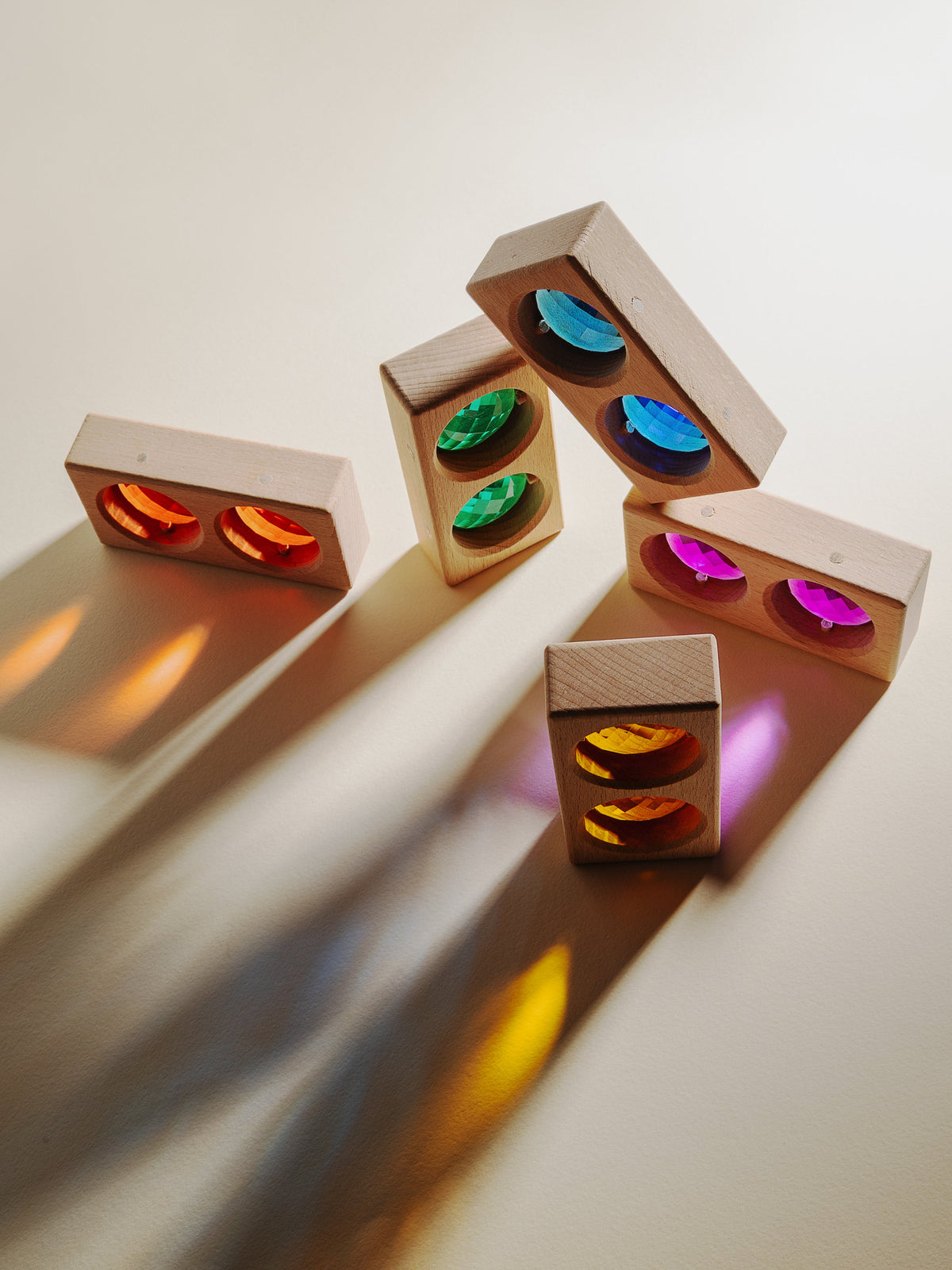
For grandparents shopping across multiple age bands, the Wooden Toys collection at Maison Rue includes thoughtfully designed options like the Pastel Juni Blocks, Primary Juni Blocks, and Malibu Puzzle that span the under-5 range.
How to Decode Safety Labels (Without a Chemistry Degree)
Here's an uncomfortable truth: "non-toxic" has no standardized legal definition in the toy industry. It's a marketing term, not a certification. Seeing it on a box tells you very little on its own.
What actually matters are verifiable standards. ASTM F963 is the mandatory U.S. baseline safety standard. Every toy sold in America must meet it. Think of it as the minimum requirement, not a badge of excellence. It covers mechanical hazards, flammability, and certain chemical limits.
EN71 is the European Union standard, widely considered more stringent. EN71-3 specifically tests for toxic element migration from paints and finishes, meaning it checks whether harmful chemicals can leach out of a toy's surface during play. Even for U.S. buyers, seeking EN71 compliance is worth the effort. The EU approved an updated Toy Safety Regulation (TSR) in June 2025 that tightened chemical testing standards further, so brands meeting these newer requirements are ahead of the curve.
CE Marking is the EU's visible signal that a product meets its safety directives. FSC certification confirms the wood was sourced from responsibly managed forests. This matters: 62% of grandparents surveyed expressed concern about the environmental impact of plastic toys.
The practical takeaway: look for brands that publish their certifications transparently, not ones that simply print "non-toxic" on the packaging and leave it at that. Maison Rue toys, including the Otto Gemstone Vehicles and Aura Glitter Blocks, are tested to CPSIA and CPC standards using solid beechwood and translucent acrylic, offering the material transparency grandparents should expect.
The Gift Parents Will Actually Welcome Into Their Home
Nobody wants to give a gift that gets quietly donated or tucked into a closet. Here's what many grandparents don't realize: aesthetics matter to today's parents. Premium wooden toys are beautiful objects designed to live in a home, not be hidden away. Nordic-inspired design, natural wood tones, and soft palettes complement modern interiors rather than clashing with them. As featured in outlets like Vogue, Babylist, and Milk Magazine, this approach to toy design has moved well beyond niche.
The numbers back this up. A Good Housekeeping Institute survey found that 90% of parents who bought wooden toys reported their children played with them more frequently than plastic alternatives, with average play sessions of 25 minutes versus 12 minutes for plastic toys.
Consider the "toy at grandma's house" concept: a small, curated basket of open-ended wooden toys kept at your home creates a special play ritual. It reduces toy clutter at the child's house, gives visits a sense of anticipation, and builds shared memories around specific objects.
A well-made wooden toy that lasts years and passes to the next grandchild is exceptional value over time, not an extravagance. This is the direction child development and conscious gifting are heading.
Your Simple Checklist Before You Buy
Use this framework every time you shop, online or in a store:
- Is it open-ended? Can the child play with it in more than one way?
- Is it age-appropriate? Match the toy type to the developmental stage using the age-band guide above.
- Does it carry verifiable safety certifications? Look for ASTM F963, EN71, or CPSIA compliance, not just the word "non-toxic."
- Is it made from natural, durable materials? Solid wood and water-based finishes will last. Thin plywood and heavy lacquer won't.
- Will the parents welcome it into their home? Both aesthetically and philosophically?
A wooden toy that meets these five criteria is genuinely one of the most developmentally powerful, environmentally considered, and parent-approved gifts you can give a child under five. Trust your instincts, use this guide, and know that choosing thoughtfully puts you right at the heart of what matters most for your grandchild's early years.
0 commentaire