


Your 3-Year-Old Is Already Thinking Like an Engineer
Here's something that might surprise you: when a three-year-old picks up a block and figures out where it fits, they're not guessing. Eye-tracking research from Florida International University, published in Infant and Child Development in 2025, found that children as young as three use the same mental rotation strategies as adults when solving spatial puzzles. They're genuinely rotating whole objects in their minds with surprising speed and accuracy.
By age 3, a child's brain has formed roughly 1,000 trillion neural connections, twice as many as an adult brain carries. The 0-to-5 window isn't just important; it's uniquely powerful for building cognitive foundations. And the tool that unlocks this capacity isn't a flashcard or an app. It's a set of blocks. Block play is the earliest, most natural form of STEM thinking, and the research behind it is far more compelling than most parents realize.
What 'STEM Thinking' Actually Looks Like Before Age 5
When we hear "STEM," we tend to picture equations, lab coats, and coding screens. But for a child under five, STEM thinking looks completely different. It's sequencing: figuring out which block goes on first. It's prediction: guessing whether a tall tower will stand or topple. It's cause and effect: pushing a structure over and watching what happens. It's problem-solving: trying again with a wider base.
Every time a child stacks, balances, and rebuilds, they're iterating like a scientist. They form a hypothesis ("this block will fit here"), test it, observe the result, and adjust. This cycle happens dozens of times in a single play session, often without a word being spoken.
Research published in 2026 in the International Journal of Technology and Design Education used Epistemic Network Analysis to examine how preschoolers develop what researchers call Engineering Habits of Mind (EHoM) during block play. These include systems thinking, creativity, optimism, collaboration, and communication. All of them showed up in children's natural block-building behavior.
This kind of cognitive engagement begins earlier than most people assume. Brain imaging research from the Universities of Bristol and Oxford identified 16 months as a critical milestone, when toddlers begin using the prefrontal cortex more extensively for inhibitory control and early cognitive skills. Spatial play benefits start well before preschool.
The type of toy matters, too. The American Academy of Pediatrics explicitly recommends open-ended toys, including blocks, over electronic alternatives for building executive function and creativity. Single-use electronic toys direct a child toward one outcome. Open-ended materials let the child decide what happens next, and that difference shapes how their brain develops.
The Spatial Reasoning–Math Connection (And Why It Starts With Blocks)
Spatial reasoning is the ability to visualize how shapes and objects move, rotate, or fit together in space. It sounds abstract, but it's one of the strongest predictors of later success in math, science, and engineering.
The evidence for this is unusually strong. The UK Millennium Cohort Study followed 16,338 children and found that spatial construction skills measured at ages 5 and 7 directly predicted mathematics reasoning at age 17, even after controlling for other variables. That's not a short-term bump. That's a connection that held across more than a decade.
A 2025 randomized controlled trial led by Schmitt and colleagues (N=242 preschoolers from low-income families) tested this more directly. Free block play produced statistically significant improvements in geometry skills (b=0.37, p=.010) and behavioral regulation (b=0.23, p=.017) compared to usual classroom activities. Effect sizes were positive for 10 of 12 measured outcomes.
Then in 2026, a study of 110 preschoolers found that children with stronger spatial skills also built larger, more elaborate structures, reinforcing a bidirectional relationship: block play builds spatial reasoning, and spatial reasoning makes block play richer.
The long-term data is just as striking. The complexity of a child's block-building at age 4 correlates with higher mathematics achievement in high school, even after controlling for IQ. And spatial training across roughly 17,000 children has demonstrated reliable improvements in math outcomes, providing strong causal evidence for the spatial-math link.
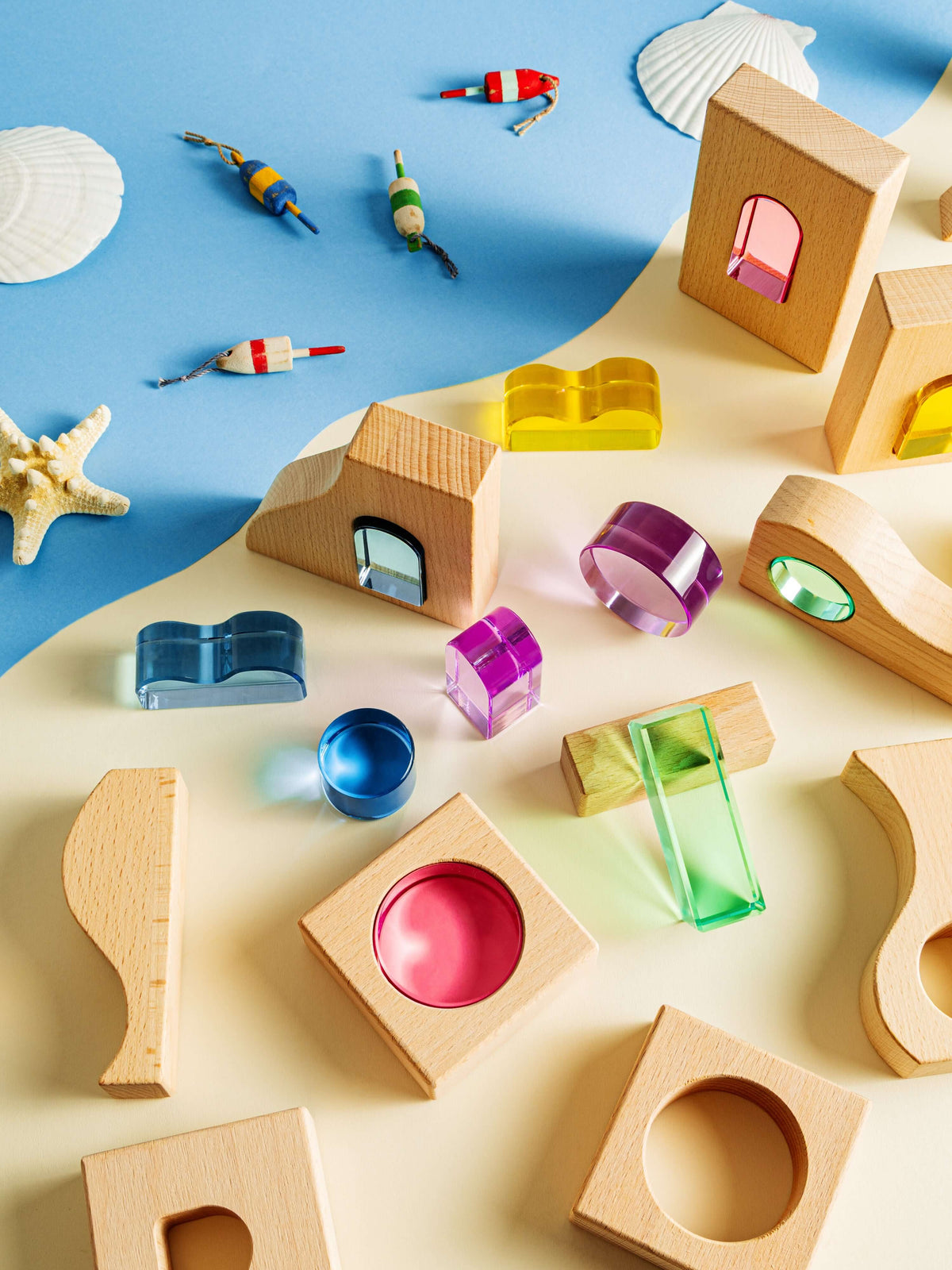
This is why open-ended blocks are so powerful. The Laguna Block Set, for instance, is built around the kind of free, exploratory building that the 2025 RCT identified as most developmentally effective: no instructions, no single correct answer, just solid wooden unit blocks that invite a child to figure things out on their own terms.
How to Amplify the Benefits: The Power of Spatial Language
What you say during block play matters as much as the play itself. FIU Professor Shannon Pruden's 2025 research found that the earlier children engage in spatial play and talk, the greater the impact on their STEM outcomes. Language shapes how children think about space.
Spatial language means using words that describe position, movement, and relationships: "above," "beside," "underneath," "taller than," "rotate." When you narrate what your child is doing with these kinds of words, you're giving them a vocabulary for the concepts they're already exploring with their hands.
A few phrases to try during any block play session:
- "You put the triangle on top of the rectangle."
- "What happens if you turn that piece around?"
- "That block is longer than the one beside it."
- "You built your tower taller than yesterday's!"
The language benefits extend beyond spatial skills. Toddlers in block play interventions scored higher on receptive language (mean 94.5 vs. 84.8) and expressive language (mean 84.3 vs. 81.6) compared to control groups. A quasi-experimental study also found that theme-based block play facilitated broader language development, reinforcing that blocks build vocabulary alongside spatial understanding.
This isn't about turning playtime into a lesson. It's about narrating what you see and letting your child's curiosity lead. Toys with interesting visual properties make this even more natural. The Lumi Glitter Blocks and Veda Glitter Blocks, with their translucent, light-catching forms, tend to prompt descriptions of color, position, and light that opaque blocks simply don't invite.
Why Material Quality Is a Developmental Choice, Not Just an Aesthetic One
Not all blocks are created equal. Open-ended, non-prescriptive materials invite richer cognitive engagement than single-use or electronic alternatives. The research is consistent on this point: it's the open-endedness of the toy that activates the thinking.
This matters especially in the context of screen time. Currently, 59.6% of preschool children exceed the AAP's recommended one hour of daily screen time, averaging 8.12 hours per week by age 4. Mobile device screen time of one hour or more per day is associated with poorer language development among toddlers. Quality blocks aren't just a nice alternative to screens; they're an evidence-backed one.
There's also an equity dimension worth acknowledging. Research from the University of Delaware and Temple University, published in Child Development, found that children from lower-income families were already falling behind in spatial skills by age 3, largely due to limited access to blocks and spatial toys. Quality materials aren't a luxury. They're access to opportunity.
Non-toxic, tactilely rich materials, such as solid beechwood and translucent acrylic tested to CPSIA and CPC safety standards, engage the senses in ways that plastic or digital toys cannot. This sensory-cognitive connection is central to Montessori philosophy: children learn through touch, weight, and texture as much as through sight. Pieces like the Magic Holographic Gems and Otto Gemstone Vehicles extend block play into imaginative, multi-sensory territory, inviting sorting, stacking, storytelling, and spatial reasoning simultaneously, without prescribing a single outcome.
Building a Block Play Habit at Home (Without Overcomplicating It)
If the research in this article feels like a lot, here's the reassuring part: the 2025 RCT found that free block play outperformed structured classroom activities. Your job isn't to run a lesson. It's to create the conditions.
Three simple ways to do that:
- Keep blocks accessible. A dedicated low shelf where blocks are always within reach removes the friction of setup. If a child can see them, they'll reach for them.
- Rotate a small selection. You don't need every block out at once. Swapping a few pieces every week or two renews curiosity without requiring new purchases.
- Sit nearby and narrate, don't direct. Your presence matters. Your instructions don't. Describe what you see. Ask open-ended questions. Let them lead.
The aesthetic dimension plays a role here, too. Blocks that are beautiful enough to live on a shelf, rather than be hidden in a storage bin, are more likely to be played with daily. When toys complement your home instead of cluttering it, they stay out. And when they stay out, children use them.
Consistency over time is what builds the cumulative cognitive benefits the longitudinal research describes. Small daily sessions compound into meaningful developmental gains. Every tower built and knocked down, every arch attempted and collapsed, is a child's brain doing exactly what it was designed to do.
The Simplest STEM Investment You Can Make Before Kindergarten
The research threads all point in the same direction. Spatial reasoning predicts math performance well into high school. Block play builds executive function and behavioral regulation. Language grows alongside spatial skills when parents narrate play. And the 0-to-5 window, with its extraordinary density of neural connections, is uniquely powerful for all of it.
No flashcards needed. No apps. No structured drills. Just open-ended play with materials that invite curiosity, and a parent willing to sit close and wonder alongside their child.
As a founder with a degree in early childhood education, this is the conviction at the heart of everything we design at Maison Rue Kid. It's not about optimizing childhood. It's about honoring it, giving children the space to build, wonder, and discover who they are becoming. If you're ready to start, our open-ended toy collection is a good place to begin.
0 comentarios