


When an OT Picks Up a Toy, Here's What They're Actually Looking For
When an occupational therapist picks up a toy, they're not reading the packaging or checking the brand name. They're watching what the toy demands of a child's hands.
OTs evaluate toys across six core fine motor skill areas: shoulder stability, bilateral coordination, hand strength, grasp development, dexterity (precise, small finger movements), and sensory motor development. Each area feeds into the bigger picture of how a child learns to use their hands with control and confidence.
The principle at work is called skill isolation. A high-value toy targets one developmental sub-skill at a time (pincer grasp, tripod grasp, in-hand manipulation, or bilateral coordination) before a child integrates it into more complex tasks. This is the opposite of toys that do everything for the child. OTs actively steer away from those because passive play builds no motor competence.
By the end of this article, you'll have the OT evaluation framework itself, not just another toy list. As a founder with a degree in early childhood education and a parent myself, I want to give you the same lens I use when designing toys for young hands.
The Fine Motor Crisis No One Is Talking About
Something has shifted in the past several years, and the numbers tell a stark story. In a recent Education Week survey, 77% of PreK-3 teachers reported that fine motor skills like holding pencils, using scissors, and writing have become significantly more challenging for young students compared to five years ago.
A 2026 EdWeek Research Center survey confirmed the trend: more than half of respondents said students' age-appropriate fine motor skills have declined over the past two years. And 77% of those respondents pointed to a single contributing factor: increased screen time.
The screen time data is sobering. Nearly 40% of 2-year-olds now have their own tablets. And 75% of parents whose children use screen media impose no limits at all. A 2025 study found that iPad screen time exceeding one hour was negatively associated with fine motor scores in preschoolers aged 34 to 50 months, with average total screen time clocking in at nearly two hours per day.
Pediatric OTs across the country are reporting significant fine motor deficits in children entering kindergarten, a trend they attribute directly to decreased hands-on play. The hands that should be stacking, threading, and building are swiping instead.
This isn't about guilt. Every parent is doing their best with the hours they have. But here's what's encouraging: the fix is simpler and more beautiful than most parents expect. It starts with what's already within reach: the toys in your home.
Why Fine Motor Skills Are an Academic Foundation, Not Just a Childhood Milestone
Fine motor development isn't a box to check before kindergarten. It's a foundation that shapes how children learn for years to come.
Research from the University of Bristol found that fine motor skills at age four significantly predicted academic success by age six. A 2025 school-readiness study of 108 preschoolers went further: fine motor skills alone explained 46% of school readiness variation before any program intervention even began.
The evidence extends well beyond a single study. A meta-analysis published in Educational Research Review, drawing on 118 studies involving nearly 80,000 children and adolescents, found a clear and consistent link between fine motor skills and academic performance across reading, writing, mathematics, and broader cognitive measures.
A 2025 systematic review put specific numbers to the relationship: a correlation of 0.60 between fine motor skills and preschool math skills, and 0.35 between fine motor skills and reading ability. These are not small effects.
Consider what a typical school day looks like. Primary school children spend 18 to 47% of classroom time on fine motor activities, primarily handwriting. Handwriting disorders (dysgraphia) affect 5 to 10% of school-aged children, and fine motor coordination is a key prerequisite for handwriting readiness.
When we reframe it this way, the toy-buying decision takes on new weight. Choosing the right toy during the 0 to 5 window isn't just about play. It's an investment in measurable, long-term academic outcomes. The research is unambiguous on this point.
The OT Toy Evaluation Framework: What Makes a Toy Developmentally Valuable
How do occupational therapists actually decide which toys are worth recommending? They assess toys against specific sub-skills, not generic age labels. The criteria include pincer grasp, tripod grasp, bilateral coordination, in-hand manipulation, and hand strength.
A good toy matches the child's developmental level, hand size, interests, and supervision needs. The number on the box is a rough guide at best. OTs look deeper: does this toy meet this child where they are right now?
Through an OT lens, open-ended toys stand apart. Toys that require active hand engagement (stacking, nesting, transferring, balancing, building) build real motor competence because the child's hands are doing the work, not a button or a battery.
This is why OT-recommended toy types tend to follow a pattern: stacking toys, wooden peg puzzles, bead threading sets, building blocks. Each is chosen for a specific developmental reason. Stacking builds bilateral coordination. Threading targets pincer grasp. Blocks develop in-hand manipulation and grip strength.
The connection to Montessori principles is direct. Wooden Montessori toys are designed to isolate learning concepts, building fine motor skills, imaginative thinking, and concentration. This mirrors the OT approach of targeting one skill before integrating it into complex tasks.
The research on puzzle play illustrates the stakes clearly. Among children with appropriate puzzle-play activities, 83.3% had normal fine motor development, versus only 22.2% among children with inappropriate puzzle-play activities.
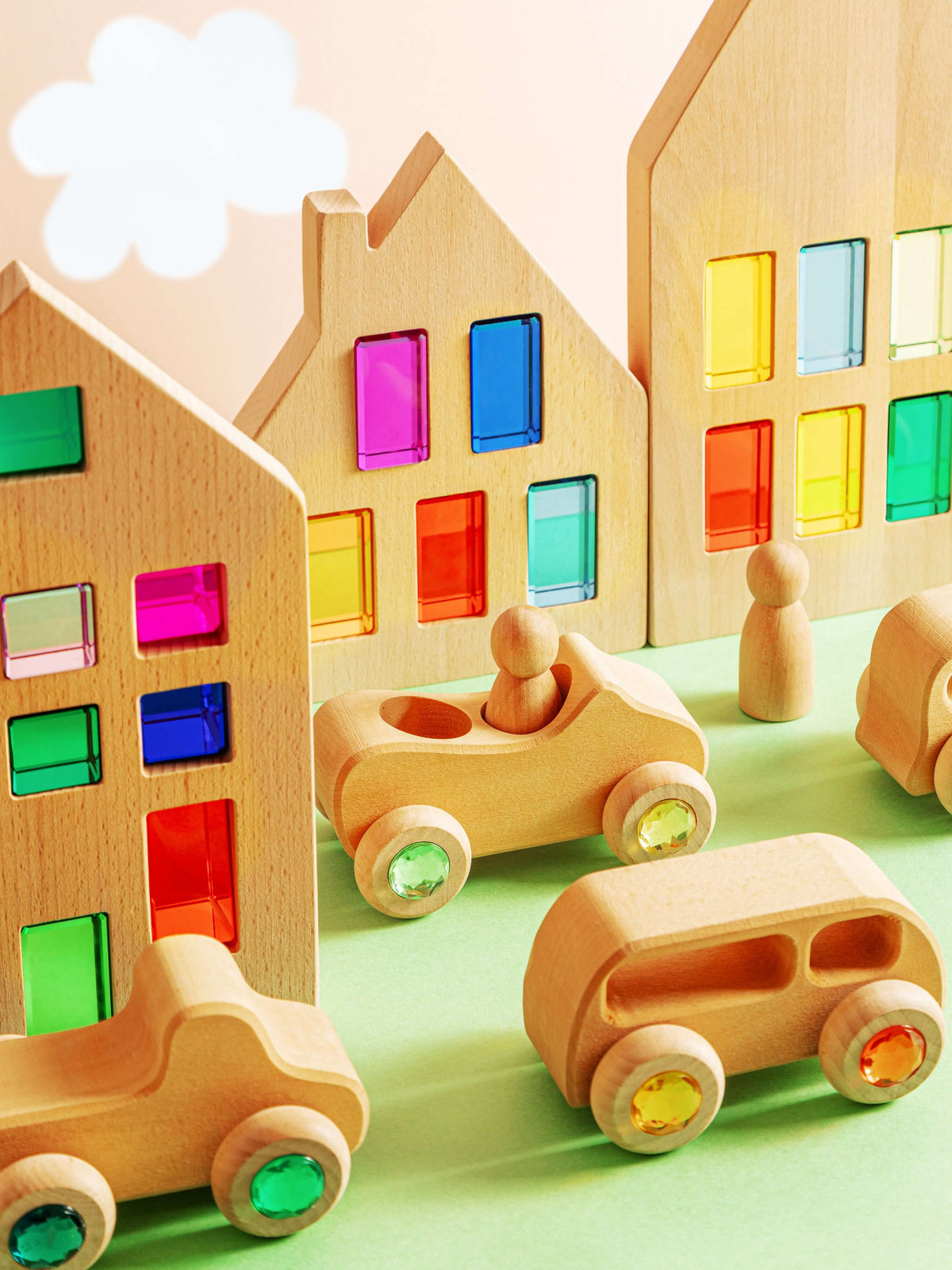
The Riley Blocks Set (Preorder) is a natural example of this kind of toy: open-ended wooden city blocks and gems that invite building, stacking, and imaginative storytelling. That active, multi-skill hand engagement is exactly what OTs look for when evaluating a toy's developmental value.
Why Material Matters More Than You Think for Fine Motor Toys
The material a toy is made from isn't just an aesthetic choice. It's a sensory one, and sensory input is inseparable from fine motor development.
Wood's natural grain, weight, temperature, and texture provide richer tactile feedback than plastic. This sensory richness directly supports fine motor and sensory integration development. A wooden block feels different in a child's hand than a hollow plastic one, and that difference matters. Wood's natural resistance requires more intentional grip and hand engagement, building hand strength and endurance through ordinary play.
There's a safety dimension here that few articles address. Fine motor toys spend more time in hands and mouths than almost any other toy type. During the developmental window when chemical exposure is most impactful, non-toxic materials aren't a luxury; they're a necessity.
The power of sensory-rich play is well documented. A 2024 sensory play intervention study found that before intervention, 100% of preschool children scored in the "Beginning to Develop" fine motor category. After intervention with tactile, sensory-rich activities, 95% had transitioned to "Developing as Expected."
At Maison Rue Kid, our toys are made from solid beechwood and translucent acrylic, tested to CPSIA and CPC safety standards. They're designed for the hands (and mouths) of young children without compromise on material integrity.
How to Use Everyday Play as Informal Fine Motor Therapy at Home
You don't need a clinical setting to support fine motor development. The right toys, used with a little intention, can bridge the gap between OT sessions and home life.
Here's a simple framework: choose one toy that targets one sub-skill. Stacking for bilateral coordination. Threading for pincer grasp. Building blocks for in-hand manipulation and grip. Keep it focused.
Short, engaged play sessions work better than long passive ones. OTs note that skill isolation is most effective in brief, concentrated bursts. Five to ten minutes of active, hands-on play accomplishes more than an hour of passive toy interaction.
Follow your child's interests and developmental readiness, not just age labels. A toy that frustrates rather than challenges will be abandoned. The sweet spot is a task that's just slightly beyond what your child can do comfortably: enough to stretch, not enough to discourage.
The most powerful thing you can do is create a home environment where hands are busy, curious, and free to explore, with toys worthy of the work they'll do.
Choosing with Intention
The OT framework, distilled to its simplest form: look for toys that demand active hand engagement, isolate a specific skill, match your child's developmental stage, and are made from materials safe enough for the hands and mouths doing the work.
The 0 to 5 window is brief and irreplaceable. The toys in your home during these years are doing more developmental work than most parents realize. Every stack, every grasp, every careful placement of one block on top of another is building neural pathways that will show up in a classroom years from now.
Extraordinary toys for everyday wonder aren't just beautiful objects. They're the quiet, intentional tools that build the hands, minds, and confidence children carry into school and beyond. As a mom, an early childhood educator, and the founder of a women-owned small business in Los Angeles, that's the standard I hold every single toy to. It's the standard your child's hands deserve.
0 comments