

One Teaches Rules. The Other Teaches Imagination. Both Matter.
Here's the simplest way to think about it: a stacking tower has one correct answer. A rainbow stacker has infinite ones. That difference shapes everything, from the skills each toy builds to the age it works best.
As a mom with a degree in Early Childhood Education, I've spent a lot of time thinking about which toys actually earn their place on the shelf. Rather than a vague "it depends," I want to walk you through a clear, age-based answer.
These two toys serve distinct developmental windows. They work best as complements, not competitors. Here's why.
What Stacking Towers Actually Teach (And When They Shine)
Stacking towers (the classic ring-on-a-peg kind) teach something called seriation: the cognitive skill of ordering objects by size, from largest to smallest. It sounds simple, but seriation is foundational to understanding number lines, measurement, and ordered data later on. This skill typically starts to emerge between 13 and 15 months.
The fine motor demands are specific, too. Threading a ring over a peg requires a pincer grasp and voluntary release control, the ability to intentionally let go of an object at the right moment. That's a more precise movement than balancing an arch, making stacking towers especially effective for children between 12 and 24 months.
The milestones back this up. According to CDC data, 75% of children can stack two blocks by around 15 months. By 12 months, most infants manage two blocks; by 18 months, a tower of three to four; and by 24 months, six or more. Both the World Health Organization and the American Academy of Pediatrics include stacking ability in their early childhood developmental indicators and toddler wellness screenings.
There's also a built-in learning loop: when the tower topples, your child learns self-correction without needing you to step in. That natural consequence is quietly powerful.
The science behind this simple toy is real. A 2024 meta-analysis published in Frontiers in Sports and Active Living found a statistically significant link between preschool fine motor skills and academic outcomes, particularly in math. A 2026 study in Frontiers in Psychology confirmed that children with strong visual-motor integration in preschool outperformed peers on standardized math tests in grades 3, 4, and 5.
What Rainbow Stackers Actually Teach (And Why They Last for Years)
Rainbow stackers are Waldorf-inspired and genuinely open-ended. There's no single correct outcome, which means your child leads the play. That freedom supports creativity, problem-solving, and intrinsic motivation in ways that structured toys simply can't.
The developmental arc is what makes them remarkable:
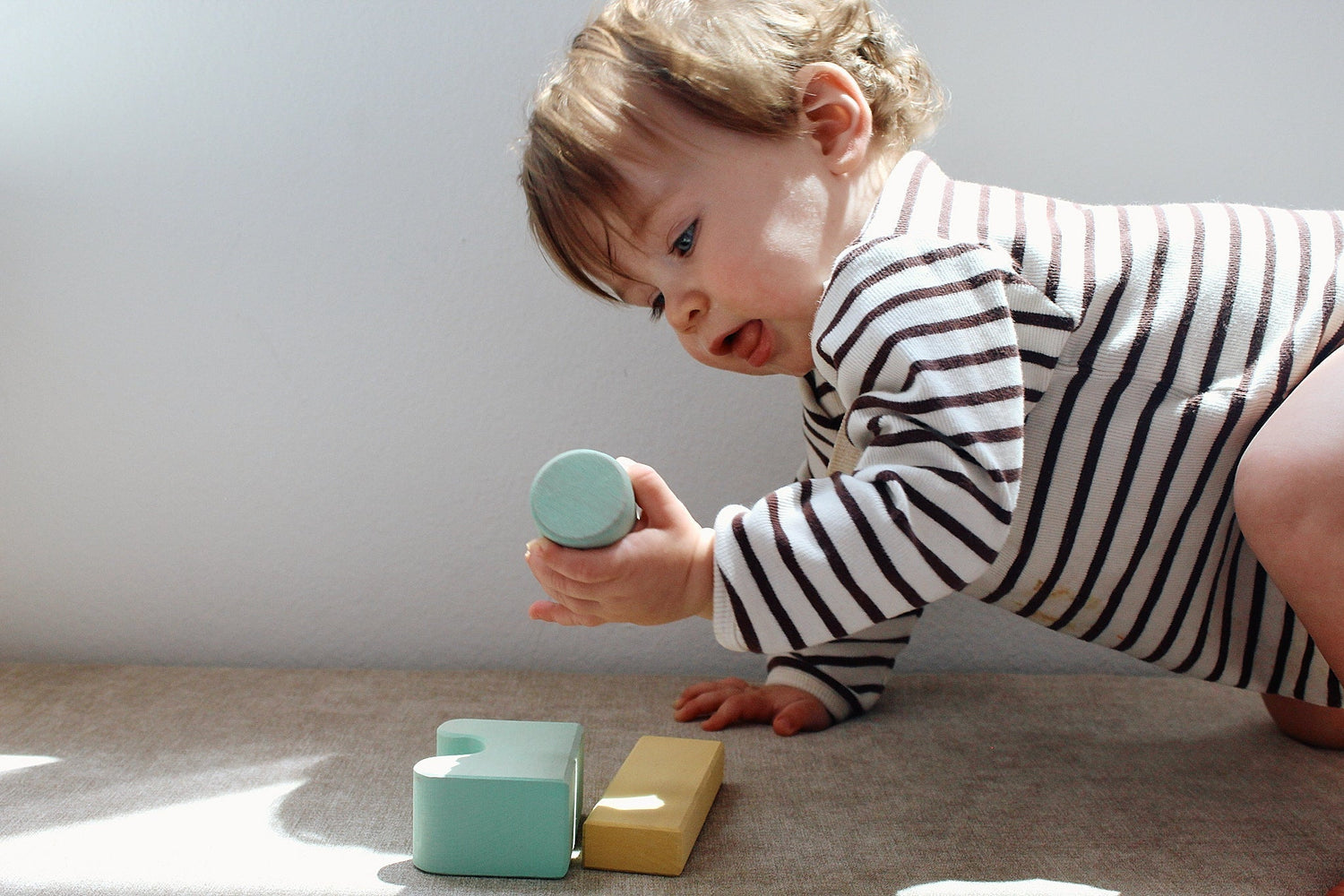
- 6–12 months: Grasping, mouthing, and sensory exploration. The arches are satisfying to hold and safe to mouth.
- 18 months–3 years: Stacking, sorting, and color matching. Children begin building simple towers and experimenting with balance.
- 3–5+ years: The arches become tunnels, bridges, fences for animal figurines, and STEM building materials. This is where imaginative play takes over.
Occupational therapists note that the rhythmic, repetitive action of stacking arches supports bilateral hand use and can be calming for sensory-sensitive children. The fine motor challenge differs from a peg tower: balancing a curved arch develops spatial reasoning and hand-eye coordination in its own distinct way. Both are valuable, just not identical.
Our Large Wooden Rainbow is a good example of this kind of toy, designed to grow with your child from 6 months to 5+ years, with non-toxic materials independently tested to CPSIA and CPC safety standards.
There's also the practical reality that design-conscious families appreciate: rainbow stackers are beautiful enough to leave on a shelf or coffee table. That aesthetic value isn't vanity. It means the toy stays accessible rather than hidden in a bin, which means more play.
Age-by-Age: Which Toy to Reach for First
6–12 months: Rainbow stacker wins. It's safe for mouthing, easy to grasp, and well-suited for sensory exploration. A stacking tower isn't very relevant yet.
12–24 months: The stacking tower is the developmental star here. Seriation, pincer grasp, voluntary release, and sequencing are all in peak development. Your rainbow stacker still earns its keep for sensory play, but the tower is doing the heavy lifting.
2–3 years: Both toys shine together. The tower reinforces ordered thinking while the rainbow stacker expands into sorting, color play, and early imaginative scenarios.
3–5+ years: The rainbow stacker takes the lead again. It becomes a tunnel, a bridge, a storytelling prop, a STEM tool. The stacking tower may feel mastered and less engaging by now.
Owning both is a curated choice, not a cluttered one. Each earns its shelf space at a different stage.
So, Do You Need Both?
This isn't really either/or. It's about knowing which to prioritize first based on where your child is right now. Put simply: stacking towers build the rules; rainbow stackers teach children what to do once they know them.
An intentional toy shelf doesn't need to be large. Two well-chosen toys that serve different developmental purposes is exactly the Montessori-aligned approach. You don't need twenty options. You need the right ones at the right time.
Both are screen-free, battery-free investments that outlast trends and grow with your child. That's the kind of simplicity tired parents (myself included) can feel good about.





0 commentaire